
The Home Valuation Funnel: How Top Agents Turn Curious Homeowners Into Listing Appointments
A step-by-step playbook for building a home valuation funnel — traffic sources, landing pages, follow-up sequences, CMA presentations, and the ROI math that makes it all work.
1. Why Home Valuations Are the #1 Seller Lead Magnet
Here's a stat that should reshape how you think about seller lead generation: 15% of homeowners who request an automated home valuation end up listing their property within 12 months. That's not a typo. One in seven people who type their address into a "What's my home worth?" page will become a seller within a year.
Compare that to cold-calling expireds (1-3% conversion), door knocking (0.5-1%), or buying Zillow seller leads at $180 a pop with no guarantee of contact. The home valuation funnel works because it starts with the homeowner's curiosity rather than the agent's interruption. Nobody asked you to call them about their expired listing. But when someone voluntarily enters their address to find out what their home is worth, they're telling you something important: they're at least thinking about selling.
According to the NAR 2025 Profile of Home Buyers and Sellers, 91% of sellers eventually use an agent — a record high. Only 5% go FSBO. The question isn't whether sellers will hire agents. The question is which agent they'll hire. And increasingly, the answer is: the one who showed up first with something useful.
That "something useful" is a home valuation. It costs you almost nothing to deliver. It positions you as the local expert. And it creates a natural reason to follow up — "I wanted to make sure the automated estimate matched what I'm seeing in your specific neighborhood." That single sentence has launched more listing conversations than any script ever written.
This guide walks you through every stage of the home valuation funnel: how to drive traffic, build landing pages that convert, deliver the valuation, follow up without being annoying, and ultimately turn that initial curiosity into a signed listing agreement. We'll cover the math, the tools, the templates, and the mistakes that kill most agents' funnels before they ever produce a result.
2. The Anatomy of a Home Valuation Funnel
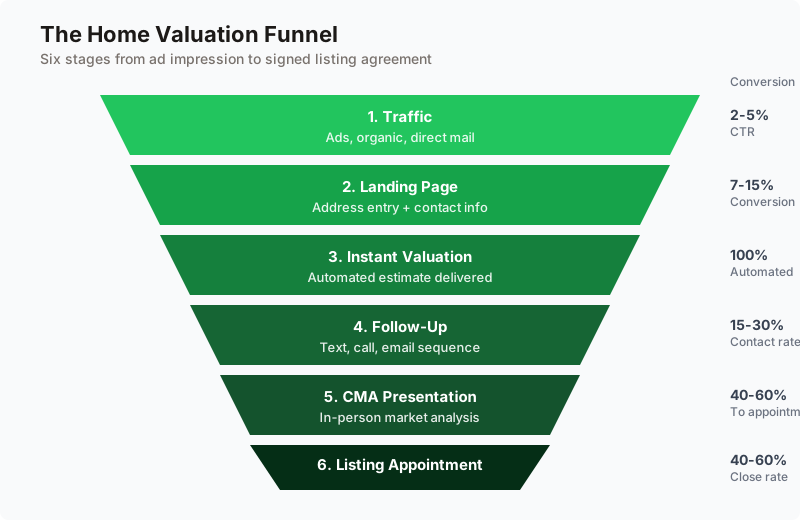
Before we build anything, let's understand what we're building. A home valuation funnel has six distinct stages, and each one has its own conversion rate, its own failure modes, and its own optimization levers.
| Funnel Stage | What Happens | Typical Conversion Rate | Key Metric |
|---|---|---|---|
| 1. Traffic | Homeowner sees your ad or content | 2-5% CTR | Cost per click (CPC) |
| 2. Landing page | Homeowner enters their address | 7-15% conversion | Cost per lead (CPL) |
| 3. Instant valuation | Homeowner receives automated estimate | 100% (automated) | Engagement rate |
| 4. Follow-up | Agent contacts lead via text/email/phone | 15-30% contact rate | Speed to lead |
| 5. CMA presentation | Agent delivers detailed market analysis | 40-60% to appointment | CMA delivery rate |
| 6. Listing appointment | Agent presents and closes | 40-60% close rate | Cost per listing |
Here's what the math looks like end-to-end: for every 1,000 people who see your home valuation ad, roughly 30-50 will click. Of those, 3-7 will enter their address. Of those leads, you'll make meaningful contact with 1-2 over the following weeks. And of those conversations, roughly half will lead to a listing appointment. The overall conversion from impression to listing is tiny — but the economics work because listings are worth $10,000+ in commission.
The key insight: you don't optimize the whole funnel at once. You find the weakest stage and fix that one. If your landing page converts at 15% but you only contact 10% of your leads, your follow-up process is the bottleneck — not your ad creative. If your ads get a 5% CTR but your landing page converts at 3%, your page is the problem. Knowing where to focus saves you from wasting money on the wrong fix.
3. Traffic Sources: Where Homeowners First See Your Offer
Every home valuation funnel starts with eyeballs. Homeowners need to see your "What's your home worth?" offer before they can act on it. The three primary traffic channels — Facebook/Instagram, Google Ads, and organic content — each attract homeowners at different stages of the selling decision, and understanding those stages determines your messaging, your budget, and your follow-up approach.
Facebook and Instagram Ads
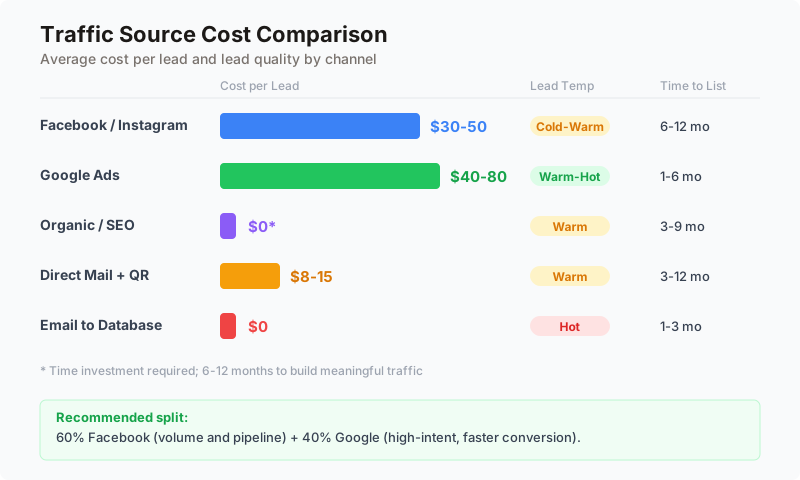
Facebook remains the most popular channel for home valuation lead generation, and for good reason: you can target homeowners in specific zip codes, at specific income levels, with specific life events (recently engaged, new job, growing family). A budget of $15-25 per day typically generates 10-20 leads per month at $30-50 per lead.
The leads are cheaper than Google, but they're also colder. Facebook users aren't searching for "how much is my home worth" — they're scrolling and your ad interrupts them. That means Facebook valuation leads need more nurturing. Expect a 3-5% conversion to listing appointment over 6-12 months, compared to Google's 5-8% over a shorter timeline.
The winning Facebook ad formula for home valuations is strikingly simple: a clean image of a house in your farm area (not a stock photo), a headline that references the specific location ("Durham Homeowners: Your Home May Be Worth More Than You Think"), and a call to action that promises speed and simplicity ("Get Your Free Estimate in 60 Seconds"). For the full campaign architecture, creative frameworks, and CPL benchmarks, see our Facebook & Instagram Ads for Seller Leads playbook.
Google Ads
Google Ads for home valuations cost more — typically $15-50 per lead — but the leads are significantly warmer. Someone who types "what is my house worth" into Google has active intent. They're not passively scrolling; they're actively seeking information about selling. Google converts 3-5x better than social for seller leads, according to data from Sierra Interactive and CINC.
The challenge with Google is competition. National players like Zillow, Redfin, and Realtor.com dominate the broad terms. Your edge as a local agent is hyperlocal targeting: "home value estimate [your city]" or "what is my house worth in [neighborhood]." These long-tail keywords cost less and attract more relevant homeowners.
Organic Content and Social Media
The cheapest traffic source — and the slowest to build — is organic. Blog posts about local market trends ("Your Neighborhood's Home Values Rose 8% This Year"), monthly market update emails to your database, and social media posts showing recent sales with commentary all drive homeowners to your valuation page without ad spend.
Organic takes 6-12 months to build meaningful traffic, but once established, it compounds. A well-ranked blog post can generate 20-50 valuation requests per month indefinitely. The key is consistency: publishing local market content weekly, not sporadically.
| Traffic Source | Avg CPL | Lead Temperature | Time to Listing | Best For |
|---|---|---|---|---|
| Facebook/Instagram Ads | $30-50 | Cold-Warm | 6-12 months | Volume, brand building, pipeline |
| Google Ads | $40-80 | Warm-Hot | 1-6 months | High-intent sellers, faster conversion |
| Organic / SEO | $0 (time investment) | Warm | 3-9 months | Long-term, compounding returns |
| Direct mail + QR code | $8-15/piece | Warm | 3-12 months | Farming, geographic targeting |
| Email to database | $0 | Hot | 1-3 months | Past clients, SOI, repeat business |
4. The Landing Page: Converting Clicks to Leads
Your landing page is where the funnel lives or dies. Industry data shows that real estate landing pages convert at 7.4% on average, but the best-performing home valuation pages hit 15-25%. The difference between a 7% and a 20% conversion rate means the difference between paying $70 per lead and $25 per lead — on the same ad spend.
What High-Converting Valuation Pages Have in Common
After analyzing hundreds of home valuation landing pages, the patterns are clear. Pages that convert above 15% share five characteristics:
- A single, clear promise. "Get your free home valuation in 60 seconds." Not "learn about the market" or "contact us for more information." One action, one benefit, one button.
- Minimal form fields. Address is essential. Email and phone are necessary. Everything else is friction. Reducing form fields from 7 to 3-4 increases conversion by up to 112%, according to Unbounce's conversion benchmark data. Every additional field you add loses you leads.
- Mobile optimization. Over 70% of home valuation traffic arrives on mobile devices. If your page isn't designed mobile-first — large tap targets, no horizontal scrolling, fast load times — you're losing the majority of your traffic.
- Social proof. A testimonial from a past seller, a "Trusted by 500+ homeowners in [city]" badge, or your agent headshot with credentials. Something that says "this person is real and other people have used this."
- No navigation. A landing page has one job: convert the visitor. Top navigation, sidebar links, and footer menus all give visitors escape routes. Remove them. The only clickable elements should be the form submit button and your phone number.
Question-Flow vs Single-Page Forms
Traditional home valuation landing pages ask for everything at once: address, name, email, phone, timeline, property type. It feels like a wall of form fields, and many visitors bounce before completing it.
Question-flow pages — sometimes called multi-step or conversational forms — break the same information into sequential screens. Screen one asks for the address. Screen two asks about the property (beds, baths, condition). Screen three asks about timeline ("Are you thinking of selling in the next 3 months, 6 months, or just curious?"). Screen four collects contact info.
The data overwhelmingly favors question flows. Heyflow and similar platforms report 40-80% higher conversion rates compared to single-page forms, with a 31% reduction in cost per lead. The psychology is simple: by the time someone has entered their address and answered two questions, they've invested effort. Completing the final step (providing contact info) feels natural rather than intrusive.
For a deep dive on building high-converting seller lead pages, see our seller lead landing pages guide.
Question-flow pages convert 40-80% higher than static forms
RobinFlow landing pages use multi-step question flows that pre-qualify seller leads before they hit your CRM. Every lead arrives with timeline, motivation, and property details attached.
5. Delivering the Valuation: Automated Estimates vs. Agent-Branded Reports
Once someone enters their address, you have a decision: what do they see next? The two main approaches — instant automated valuations and agent-prepared CMAs — serve different purposes, and the smartest agents use both at different stages of the funnel.
Automated Valuation Models (AVMs)
Automated valuations use algorithms to estimate a home's value based on comparable sales, tax assessments, and property characteristics. The major AVMs — Zillow's Zestimate, Redfin's Estimate, Realtor.com's valuation tool, and others from CoreLogic, HouseCanary, and ATTOM — all produce instant estimates without human involvement.
The accuracy varies. Zillow's Zestimate has a median error of 7.49% for off-market homes. Redfin's Estimate comes in slightly better at 6.47%. For a $400,000 home, that's a $26,000-$30,000 margin of error. That's significant — and it's exactly the conversation-starter you need.
The instant valuation serves two critical functions in your funnel: it delivers on the promise of your landing page (the homeowner gets a number immediately, not "an agent will contact you"), and it creates a natural opening for follow-up ("The automated estimate for your home came in at $415,000, but based on recent sales on your street, I think the range may actually be $430,000-$445,000. Want me to put together a detailed analysis?").
Agent-Branded Comparative Market Analysis (CMA)
A CMA is what separates you from Zillow. Anyone can run an automated estimate. Only a local agent can pull three genuinely comparable sales, adjust for the homeowner's specific upgrades, account for the micro-location differences between streets in the same neighborhood, and present a defensible price range.
Tools like Cloud CMA (used by 650,000+ agents with over 5.4 million reports generated) let you create polished, branded CMA presentations in under 15 minutes. The presentation includes comparable sales with photos, market trend charts, your recommended list price range, and your agent branding throughout.
The CMA isn't the lead magnet — the instant valuation is. The CMA is the conversion tool. You offer it as the logical next step: "I put together a detailed analysis of your home based on recent sales in your specific neighborhood. Can I drop it by this week, or would you prefer I email a summary?" That's a listing appointment, disguised as a delivery.
| Feature | Automated Valuation (AVM) | Agent CMA |
|---|---|---|
| Delivery speed | Instant | 15 min - 24 hours |
| Accuracy | 6-8% median error | 1-3% when done well |
| Cost to agent | Per-credit or subscription | Time investment |
| Homeowner perception | Convenient, impersonal | Professional, trustworthy |
| Funnel role | Lead magnet (top of funnel) | Conversion tool (bottom of funnel) |
| Competitive moat | None — Zillow does this too | High — only local agents can deliver |
6. Speed to Lead: Why the First Five Minutes Matter More Than Anything
Of all the factors that determine whether a home valuation lead becomes a listing appointment, speed to lead is the most impactful and the most neglected. The data on this is unambiguous: responding to a lead within five minutes makes you 21 times more likely to make contact compared to waiting 30 minutes. Not 21% more likely. Twenty-one times.
Yet 48% of real estate agents never follow up after the first attempt. Almost half of all leads — leads that agents paid money to generate — receive a single contact attempt and then nothing. They sit in a CRM, marked as "no response," while the homeowner who was genuinely curious goes and enters their address on Zillow instead.
The Five-Minute Response Protocol
When a new home valuation lead hits your system, the clock starts. Here's the protocol that top-performing agents follow:
- 0-2 minutes: Automated text message. "Hi [First Name], this is [Your Name] with [Brokerage]. I just ran the initial estimate for [Address]. I'll have a more detailed analysis for you shortly. In the meantime, is there anything specific about the current market you're curious about?" This confirms the lead is real and sets an expectation for follow-up.
- 2-5 minutes: Phone call attempt. Call the lead. If they answer, you're in a conversation. If they don't, leave a voicemail that references the valuation they just requested. Don't pitch. Don't ask for a listing appointment. Just offer information: "I noticed you requested a valuation for your home on Oak Street. I wanted to give you some context on what's happening in your specific neighborhood — we've seen some interesting activity in the last 90 days."
- 5-15 minutes: Personalized email. Send a brief email with one or two relevant data points about their neighborhood. Include your headshot, your phone number, and a link to a detailed market report. No attachments — just a clean, scannable email that adds value.
That triple-touch in 15 minutes (text, call, email) reaches the homeowner on three different channels. If they prefer text, they'll respond there. If they're an email person, they'll reply to that. If they answer the phone, even better. You're not being pushy — you're being responsive to something they requested.
The best call times for reaching home valuation leads are 8-9 AM and 4-5 PM, with Wednesday and Thursday being the highest-contact days. But those are for cold outreach. For inbound home valuation leads, the best time to call is right now — the moment the lead comes in. Time of day statistics don't apply when someone just told you they want to know what their home is worth.
7. The Follow-Up Sequence: From Lead to Conversation
Speed to lead handles the first 15 minutes. But 80% of sales require five or more follow-up touches, and the average home valuation lead needs 8-12 touchpoints before converting to a listing appointment. Your follow-up sequence is the bridge between "I requested a valuation" and "I'm ready to talk about selling."
The 30-Day Drip Framework
After the initial triple-touch (text, call, email on day one), the most effective follow-up cadence follows this pattern:
- Day 1: Automated text + phone call + email (already done in your speed-to-lead protocol)
- Day 3: Email with a neighborhood market snapshot — "3 homes sold within half a mile of you in the last 30 days." Include sale prices and days on market.
- Day 6: Text message — "Quick question: are you thinking about selling in the next few months, or just curious about value? Either way is totally fine — helps me know what info to send you."
- Day 10: Email with a CMA teaser — "I pulled the comps for [Street Name]. A few things surprised me. Would you like me to put together a full analysis?"
- Day 14: Phone call attempt. Reference previous touchpoints: "I sent you some market data last week for your neighborhood. Did you get a chance to look at it?"
- Day 21: Email with a relevant article or market trend — "Mortgage rates hit [X]% this week. Here's what that means for home values in [City]."
- Day 30: Final "soft ask" text — "Just checking in on the valuation I sent for [Address]. If you're thinking about next steps, I'm happy to walk through the numbers in person. No pressure either way."
After 30 days, move unresponsive leads to a monthly nurture sequence. This is not abandoning them — it's acknowledging their timeline. Remember, 15% of valuation requesters list within 12 months. Many won't be ready for 6-9 months. Monthly touchpoints keep you top-of-mind without burning the relationship.
Monthly Nurture: The Long Game
Monthly nurture emails should provide genuine value, not just "checking in." Tools like HomeBot — which achieves a 52% email open rate, three times the 19% industry average — automate monthly home value updates that homeowners actually read. Each email shows the homeowner their estimated equity, their estimated monthly payment breakdown, and a market trend summary.
The power of monthly nurture isn't any single email. It's the cumulative effect. After six months of seeing their home value trend upward (or seeing equity they didn't know they had), the homeowner's curiosity shifts from passive to active. And when it does, your name is the one attached to every update they've received.
8. The CMA Presentation: Your Listing Appointment Invitation
The CMA is where the home valuation funnel transitions from digital marketing to face-to-face relationship building — and your listing presentation is where that relationship converts into a signed agreement. When done right, the CMA presentation isn't something you pitch to the homeowner — it's something they ask for. Your follow-up sequence should make the CMA feel like the natural next step.
Building a CMA That Wins Listings
A winning CMA includes five elements that address every seller's core questions:
- Three to five genuinely comparable sales. Not just "homes that sold nearby." Comparables should match the subject property's size, age, condition, and location within a quarter-mile radius. When you can't find perfect matches, explain the adjustments: "This comp is 200 square feet larger, so I adjusted down by $15,000 based on the price-per-square-foot in your subdivision."
- Active and pending listings. These show the competition. If three similar homes are currently listed between $420,000 and $440,000, the seller sees the pricing landscape they're entering. This is more persuasive than any pricing argument you could make.
- Market trend data. Average days on market, months of inventory, list-to-sale price ratio. These numbers contextualize your recommended price. "Homes in your price range are selling in 14 days with 98% of list price" tells a very different story than "Homes in your price range are sitting for 60 days and selling at 94% of list."
- A recommended price range. Not a single number. A range. "$425,000-$445,000 based on current market conditions, with $435,000 as the target that maximizes both speed and return." A range demonstrates sophistication and gives the seller room to participate in the pricing discussion.
- Your marketing plan. What specifically will you do to sell this home? Professional photography, virtual tour, social media promotion, open house strategy, broker outreach. The CMA isn't just about price — it's about what happens after the seller agrees to your price.
Full CMA presentations convert at 40-60% to a signed listing agreement when delivered in person. That conversion rate drops to 20-30% when the CMA is emailed without a live walkthrough. The in-person delivery matters because it lets you read the seller's reactions, answer objections in real time, and demonstrate the expertise that no automated report can replicate.
9. The ROI Math: Home Valuation Funnel Economics
Let's run the numbers on what a home valuation funnel actually produces. This is the math that separates agents who build sustainable lead generation from agents who throw money at ads and wonder why it didn't work.
The Unit Economics
Start with the end: the average listing-side commission on a median-priced home. According to NAR data, the median home sale price is approximately $366,000. With total commission averaging 5.70% and the listing side averaging 2.88%, that's roughly $10,500 per listing.
Now work backward through the funnel:
| Metric | Conservative | Average | Optimistic |
|---|---|---|---|
| Monthly ad spend | $1,500 | $2,000 | $2,500 |
| Cost per lead | $75 | $50 | $35 |
| Leads per month | 20 | 40 | 71 |
| Lead-to-appointment rate | 3% | 5% | 7% |
| Appointments per month | 0.6 | 2 | 5 |
| Appointment-to-listing rate | 40% | 50% | 60% |
| Listings per month | 0.24 | 1 | 3 |
| Revenue per listing | $10,500 | $10,500 | $10,500 |
| Monthly revenue | $2,520 | $10,500 | $31,500 |
| Monthly ROI | 1.7x | 5.25x | 12.6x |
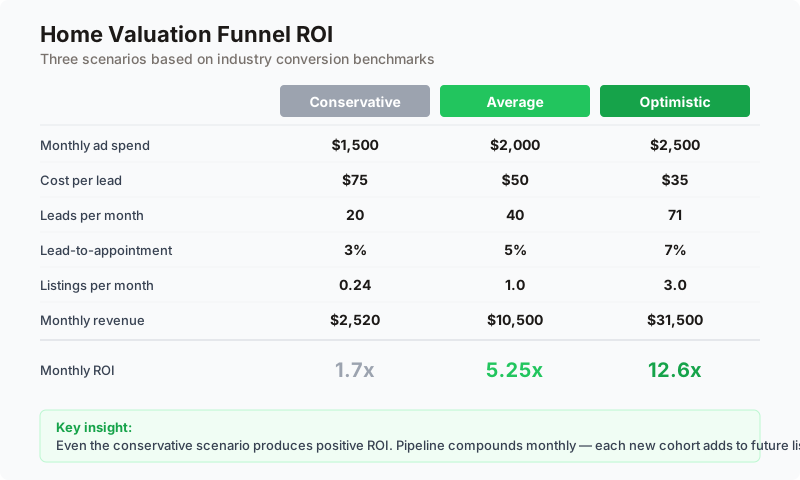
Even the conservative scenario — where everything underperforms industry averages — still produces a positive ROI. The average scenario shows $2,000 in monthly ad spend producing $10,500 in commission, a 5.25x return. And these numbers only count direct conversions within the first month. They don't include the leads who list 6-12 months later, the referrals those listings generate, or the past-client relationships you build.
The Compounding Effect
Home valuation funnels compound over time. In month one, you have 40 leads in your pipeline. In month two, you have 80 (40 new + 40 from last month still being nurtured). By month six, you have 240 leads at various stages of the selling decision. The 15% annual conversion rate means roughly 36 of those 240 leads will list within the next year — even if you turned off the ads today.
This is why agents who commit to home valuation funnels for 12+ months see dramatically different results than agents who run ads for 90 days and quit. The funnel is an asset that appreciates. Every month of lead generation adds to a pipeline that keeps producing listings months and years later.
Break-Even Analysis
The break-even point for most home valuation funnels is straightforward: one listing covers approximately $3,000-$4,000 in marketing spend at median home prices. If your annual funnel budget is $24,000 (about $2,000/month), you need three listings from the funnel to break even. Everything above three is profit.
For context, a well-run funnel at average conversion rates should produce 12+ listings per year from $24,000 in annual spend. That's $126,000 in commission against $24,000 in marketing — a 5.25x annual ROI before accounting for referrals and repeat business.
Your valuation funnel starts here
Branded landing pages with instant home valuations, question-flow lead capture, and CRM integration — all included with RobinFlow valuation credits.
10. Facebook Ads: The Home Valuation Campaign Playbook
Facebook and Instagram remain the highest-volume, lowest-cost channels for home valuation leads. Here's the specific campaign setup that consistently produces leads in the $30-50 range.
Campaign Structure
Use a Traffic or Conversions objective campaign (not Lead Form — the native Facebook lead forms skip your landing page and produce lower-quality leads). Set your audience to homeowners within your target zip codes, aged 28-65, with interests in real estate, home improvement, or home equity. Exclude renters if possible using housing-related targeting.
Start with $20/day. Run the campaign for 7 days without making changes — Facebook's algorithm needs time to optimize delivery. After 7 days, evaluate your cost per lead. If it's under $50, increase the budget by 20%. If it's over $75, test new ad creative before increasing spend.
Ad Creative That Works
The most effective home valuation ad format is a single image (not a carousel, not a video) with these elements:
- Image: A recognizable local home or neighborhood scene. Aerial neighborhood shots perform well because homeowners recognize their area. Avoid stock photos — they feel corporate and reduce trust.
- Primary text: "Thinking about selling your home in [City]? Home values in [Neighborhood/Zip] have changed significantly this year. Enter your address to see what your home is worth — free, instant, no obligation."
- Headline: "What's Your [City] Home Worth in 2026?"
- CTA button: "Learn More" (outperforms "Sign Up" for valuation offers)
Run three variations of the primary text simultaneously and let Facebook's algorithm determine the winner. After 200+ impressions per variation, pause the lowest performer and create a new variation to test against the remaining two.
Retargeting: The Second Chance
Not everyone who clicks your ad will complete the valuation form. Set up a retargeting audience of people who visited your landing page but didn't submit — and show them a different version of the ad. "Still curious about your home's value? Your free estimate is waiting." Retargeting ads to home valuation visitors increase conversion by up to 70% compared to non-retargeted traffic.
11. Google Ads: Capturing High-Intent Seller Searches
While Facebook generates volume, Google captures intent. Here's how to set up Google Ads that target homeowners actively searching for home valuations in your market.
Keyword Strategy
Target these keyword clusters, organized by intent level:
- High intent (bidding priority): "how much is my home worth [city]," "home value estimate [city]," "sell my house [city]," "what is my house worth [zip code]"
- Medium intent: "home values in [neighborhood]," "housing market [city] 2026," "[city] real estate market"
- Lower intent (brand awareness): "should I sell my home," "best time to sell a house," "how to know when to sell your home"
Use phrase match and exact match — avoid broad match, which triggers your ads for irrelevant searches and burns budget. Add negative keywords aggressively: "rent," "buy," "apartment," "commercial," "foreclosure." Review your search terms report weekly and add new negatives.
Landing Page Alignment
Google rewards landing page relevance with lower costs per click. Your Google Ads landing page should mirror the search query as closely as possible. If someone searches "what is my home worth in Durham," your landing page headline should be "What's Your Durham Home Worth?" not a generic "Free Home Valuation." Create separate landing pages for your top 3-5 target cities or neighborhoods.
For more on integrating paid lead sources with your CRM, see our CRM comparison guide.
12. Text and Email Follow-Up Templates
Templates save time and ensure consistency. Here are field-tested sequences for each stage of the home valuation funnel. Customize the bracketed fields for your market and personality.
Immediate Response Templates
Text (send within 2 minutes):
"Hi [First Name], this is [Your Name] with [Brokerage]. Thanks for requesting a home valuation for [Address]. I've pulled the initial estimate and wanted to share some additional context about recent sales in your area. Would you prefer I text you the highlights or send a quick email?"
Email (send within 15 minutes):
Subject: Your Home Valuation for [Address]
"Hi [First Name], Thanks for requesting a home valuation — here's what the data shows for your property. The automated estimate came in at [AVM Value], but I want to flag a few things the algorithm doesn't account for: [1-2 specific local factors — recent nearby sale, neighborhood improvement, school rezoning]. I'd be happy to put together a detailed market analysis that factors in these specifics. It takes about 15 minutes to prepare and could give you a more accurate picture of where your home stands. Would that be helpful? — [Your Name]"
Day 3 Follow-Up
Email — Neighborhood Market Snapshot:
Subject: 3 Recent Sales Near [Street Name]
"Hi [First Name], I pulled the three most recent sales within half a mile of your home: [Address 1] — $[Price], [Beds/Baths], [Days on Market] days. [Address 2] — $[Price], [Beds/Baths], [Days on Market] days. [Address 3] — $[Price], [Beds/Baths], [Days on Market] days. These give you a real-time snapshot of what buyers are paying in your immediate area. If you'd like me to dig deeper into how your specific home compares, I can have a detailed analysis ready in 24 hours. — [Your Name]"
Day 6 Timeline Qualifier
Text:
"Hey [First Name] — quick question about the valuation you requested. Are you thinking about selling in the next few months, or just keeping tabs on your home's value? Either way is great — just helps me know what info would be most useful for you."
This text is strategically important. It segments your leads without being pushy. "Next few months" responses get immediate CMA preparation. "Just curious" responses go into monthly nurture. Both answers are valid, and the homeowner feels respected rather than pressured.
13. AVM Accuracy: What You Need to Know (and Tell Homeowners)
Automated Valuation Models are essential to the funnel but deeply flawed as pricing tools. Understanding their limitations — and being transparent about them with homeowners — is what separates helpful agents from agents who look like they don't know what they're talking about.
How AVMs Calculate Value
AVMs use three primary data inputs: recent comparable sales (from MLS and public records), property characteristics (square footage, bedrooms, bathrooms, lot size from tax records), and market trends (price-per-square-foot changes over time in the area). They apply statistical models — regression analysis, machine learning, or hedonic pricing models — to weight these inputs and produce an estimate.
What AVMs cannot do: see inside the home. A house with a $60,000 kitchen renovation and one with 1985 laminate countertops look identical in the data. A home backing to a busy road and one backing to a park have the same tax record. A house with foundation issues and one with no structural problems may have the same square footage and bed/bath count. These are the gaps where your local expertise creates value.
Accuracy by Provider
| AVM Provider | Median Error (Off-Market) | Within 5% Accuracy | Within 10% Accuracy |
|---|---|---|---|
| Zillow Zestimate | 7.49% | ~50% | ~80% |
| Redfin Estimate | 6.47% | ~55% | ~83% |
| Realtor.com | ~7.5% | ~48% | ~78% |
| CoreLogic | ~5.5% | ~60% | ~85% |
For a $400,000 home, a 7% median error means the AVM could be off by $28,000 in either direction. Half the time, it's even further off than that. This isn't a knock on AVMs — they do a remarkable job given the data constraints. But it means every automated valuation comes with a built-in reason for the homeowner to talk to a local expert.
How to Frame AVM Limitations to Homeowners
Don't bash the Zestimate. Homeowners trust it, and attacking it makes you look defensive. Instead, position yourself as the person who adds the missing context:
"The automated estimate is a solid starting point — it's based on real sales data. But it can't account for things like your kitchen renovation, the fact that your lot is larger than average, or that the comp it's using on Pine Street actually had water damage. That's where a detailed analysis by someone who knows these streets makes a real difference."
This framing validates the homeowner's initial research (they feel smart for checking), introduces your expertise without being arrogant, and creates a natural path to the CMA presentation.
14. Nurturing the Long Pipeline: 12-Month Conversion Strategies
Most home valuation leads won't convert in 30 days. Many won't convert in 90 days. The 15% annual conversion rate means your pipeline is a slow cooker, not a microwave. Agents who win at home valuation funnels are the ones who build systems for the long game.
Monthly Market Updates
The most effective long-term nurture tool is the monthly market update — a brief, automated email that shows the homeowner how their home's estimated value has changed. HomeBot pioneered this approach and achieves a 52% email open rate, roughly three times the real estate email industry average of 19%.
The emails work because they're about the homeowner's home, not about you. Every subject line references their property: "Your Oak Street Home: June 2026 Update." Every email shows their estimated equity, their estimated monthly savings vs. renting, and a chart of value trends over time. Your branding is present but subtle — it's their home's story, told by you.
Lifecycle Event Triggers
Beyond monthly updates, watch for trigger events that accelerate selling timelines:
- Home equity milestones: When estimated equity crosses round numbers ($100K, $200K), send a specific message: "Your home just crossed $200,000 in estimated equity. Here's what that means for your options."
- Local market shifts: When inventory drops below 2 months in their area, when a comparable home sells above asking, or when interest rates change significantly — each is an excuse for a relevant, timely touchpoint.
- Anniversary of valuation request: "It's been a year since you checked your home's value. Here's how things have changed." This is surprisingly effective because it triggers the homeowner to compare their current situation to when they first showed interest.
- Seasonal timing: Spring and early summer are natural selling seasons. A February message — "Thinking about making a move this spring? Now's the time to start preparing" — catches sellers in the planning phase.
The Sphere Effect
Home valuation leads who don't sell themselves often know someone who's selling. By staying in their awareness with monthly updates, you become the agent they refer when a neighbor, coworker, or family member mentions they're thinking about moving. The referral value of a well-maintained pipeline is significant — and essentially free.
15. Common Mistakes That Kill Home Valuation Funnels
After reviewing hundreds of agent home valuation campaigns, these are the patterns that consistently lead to failure — and the fixes for each.
Mistake 1: Treating Every Lead the Same
A homeowner who said "I'm thinking about selling in 3 months" and one who said "just curious" require completely different follow-up strategies. The 3-month seller needs an immediate CMA offer and a listing presentation timeline. The curious homeowner needs monthly value updates and patience. If you blast the same drip sequence to both, you'll overwhelm the curious one and underwhelm the motivated one.
Mistake 2: Quitting After 60-90 Days
The median time from valuation request to listing is 6-9 months. Agents who run ads for 60-90 days and declare the funnel "doesn't work" are pulling the plug right before the pipeline starts producing. Commit to a minimum of six months — ideally twelve — before evaluating ROI.
Mistake 3: Slow Follow-Up
We've already covered the data: 21x more likely to make contact within five minutes. Yet most agents respond to home valuation leads within hours, not minutes. If you can't respond in five minutes during business hours, set up automated text messages that acknowledge the request immediately and buy you time to call personally.
Mistake 4: No CRM Integration
Home valuation leads that sit in a spreadsheet or an email inbox go stale immediately. Every lead should flow directly into your CRM with automated tagging (source: home valuation, status: new lead, timeline: TBD) and trigger an automated follow-up sequence. If your CRM isn't integrated with your valuation landing page, fix that before spending another dollar on ads. For choosing the right CRM, see our CRM comparison guide.
Mistake 5: Generic Landing Pages
A landing page that says "Free Home Valuation" with a generic house stock photo converts at half the rate of one that says "What's Your [City] Home Worth in 2026?" with a local neighborhood image. Homeowners need to see themselves in the offer. Localize everything — the headline, the image, the testimonial, and the agent branding.
Mistake 6: No Retargeting
70% of people who click your ad and land on your valuation page will leave without entering their address. Without retargeting, those clicks are wasted. A retargeting campaign costs $3-5/day and recaptures 5-10% of those bounced visitors. Over time, retargeting becomes your cheapest source of valuation leads.
Mistake 7: Overselling on First Contact
The homeowner requested a valuation, not a listing presentation. Your first contact should deliver value (the valuation data, neighborhood context, a relevant insight), not pitch your services. The listing conversation happens naturally after you've demonstrated expertise through the CMA delivery process.
16. Building Your Home Valuation Funnel with RobinFlow
RobinFlow was built specifically for the kind of funnel described in this guide. Here's how the platform's features map to each funnel stage.
Valuation Credits
RobinFlow includes valuation credits that let you deliver instant automated home valuations through your branded landing pages. When a homeowner enters their address, they receive an immediate estimate — no third-party redirect, no Zillow branding, no competitor ads. The valuation is delivered under your name, with your branding, positioning you as the source of the information.
Question-Flow Landing Pages
RobinFlow's landing pages use the multi-step question flow format that outperforms single-page forms by 40-80%. The flow collects the address, asks about property details and timeline, and captures contact information — pre-qualifying every lead before they reach your CRM. You know who's selling in three months and who's just curious before you make your first call.
CRM Integration
Leads flow directly from RobinFlow into your CRM — Follow Up Boss, kvCORE, Sierra Interactive, Lofty, or any platform with webhook or Zapier support. Each lead arrives with the qualification data from the question flow attached, so your CRM can route and tag leads based on timeline, motivation, and property details.
Agent Branding
Every touchpoint in the RobinFlow funnel carries your branding. The landing page shows your photo, your brokerage, and your contact information. The valuation report is delivered from you, not from RobinFlow. Homeowners interact with your brand from first click to last follow-up — which matters because trust in the agent's brand is what converts the lead, not trust in a software platform.
To explore how RobinFlow's landing pages compare to alternatives, see our landing page conversion guide.
Ready to launch your home valuation funnel?
Branded valuation pages, question-flow lead capture, and automated CRM delivery. Start generating seller leads this week.
Get Started Free17. Measuring What Matters: Funnel Metrics and KPIs
Running a home valuation funnel without tracking metrics is like listing a home without comps — you're guessing when you should be measuring. Here are the numbers to watch weekly and monthly.
Weekly Metrics
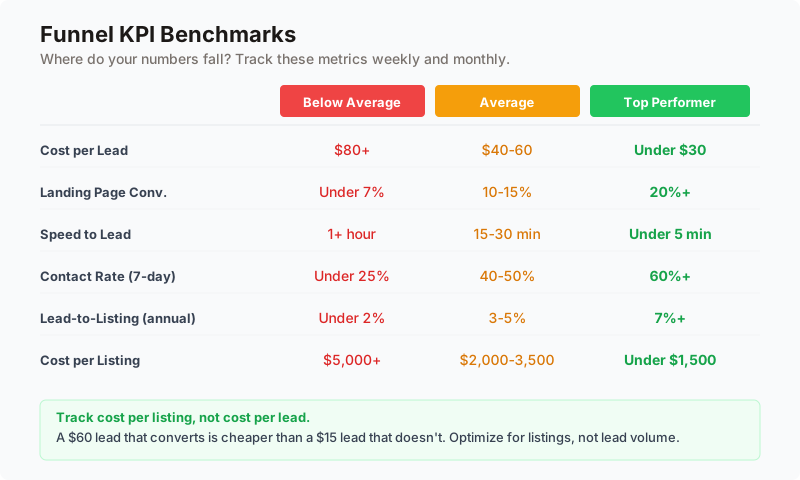
- Cost per lead (CPL): Total ad spend divided by total leads generated. Target: $30-60 for Facebook, $40-80 for Google. If CPL spikes above your target for two consecutive weeks, pause and diagnose — it's usually ad fatigue (same creative running too long) or audience exhaustion (targeting too narrow).
- Landing page conversion rate: Visitors who complete the form divided by total visitors. Target: 10-20%. Below 8% means your page needs work. Above 20% means you're doing something right — document what and replicate it.
- Speed to lead: Average time between lead submission and first agent contact. Target: under 5 minutes during business hours. Track this religiously — it's the single highest-leverage metric in the entire funnel.
- Contact rate: Percentage of leads you actually reach (via any channel). Target: 40-60% within 7 days.
Monthly Metrics
- Lead-to-appointment rate: Percentage of leads that become listing appointments. Target: 3-7% per month. This number improves as your pipeline ages — month-6 leads convert better than month-1 leads.
- Cost per appointment: Total monthly marketing spend divided by appointments set. Target: $500-$1,500 per appointment.
- Appointment-to-listing rate: Percentage of listing appointments that result in a signed agreement. Target: 40-60%.
- Cost per listing: Total marketing spend divided by listings taken. Target: under $3,000 at median home prices. Above $5,000 signals a funnel issue; below $2,000 is exceptional.
- Pipeline value: Total number of leads in active nurture multiplied by estimated conversion rate multiplied by average commission. This is the forward-looking revenue your funnel represents.
| KPI | Below Average | Average | Top Performer |
|---|---|---|---|
| Cost per lead | $80+ | $40-60 | Under $30 |
| Landing page conversion | Under 7% | 10-15% | 20%+ |
| Speed to lead | 1+ hour | 15-30 min | Under 5 min |
| Contact rate (7-day) | Under 25% | 40-50% | 60%+ |
| Lead-to-listing (annual) | Under 2% | 3-5% | 7%+ |
| Cost per listing | $5,000+ | $2,000-3,500 | Under $1,500 |
18. Putting It All Together: Your 30-Day Launch Plan
Here's the week-by-week plan to launch your home valuation funnel from scratch. Each step builds on the previous one.
Week 1: Foundation
- Choose your target area — one or two zip codes to start. Don't go broad. A narrow geographic focus produces better ad targeting, more relevant comps for follow-up, and establishes you as the hyperlocal expert.
- Set up your landing page with a question-flow format. Include your address field, timeline question, property condition question, and contact information collection.
- Connect your landing page to your CRM. Test the integration by submitting a test lead and verifying it appears in your CRM with the correct tags and triggers.
- Build your automated response sequence: immediate text message template, day-3 email template, day-6 text template, day-10 CMA offer email.
Week 2: Traffic Launch
- Create your Facebook campaign. One campaign, one ad set, three ad variations. Budget: $20/day. Audience: homeowners in your target zip codes, age 28-65.
- Set up retargeting. Install the Facebook pixel on your landing page. Create a retargeting audience of landing page visitors who didn't complete the form. Budget: $5/day for retargeting ads.
- If budget allows, create a Google Ads campaign targeting "[your city] home value" and "what is my house worth [your city]." Budget: $15-20/day.
Week 3: Optimize and Respond
- Leads should be coming in. Focus entirely on speed to lead — respond to every lead within 5 minutes during business hours. Set up phone notifications for new leads.
- Review your landing page conversion rate. If it's below 10%, test a new headline or reduce form fields.
- Prepare three CMA templates for different home types in your target area so you can deliver personalized analyses within 24 hours of request.
Week 4: Evaluate and Scale
- Review all metrics: CPL, conversion rate, contact rate, speed to lead. Identify your weakest stage and focus improvement efforts there.
- If CPL is on target, increase Facebook budget by 20%. If Google is producing higher-quality leads, shift budget accordingly.
- Begin monthly market update emails to all leads generated so far. This starts the long-term nurture that produces listings in months 6-12.
- Set a calendar reminder for a 90-day and 6-month funnel review. Resist the urge to evaluate ROI before 6 months — the pipeline needs time to mature.
19. Key Takeaways
The home valuation funnel isn't a growth hack or a shortcut. It's a structured system for turning homeowner curiosity into listing appointments, built on a simple exchange: you provide information the homeowner wants, and in return you earn the right to start a conversation about selling.
Here are the principles that make it work:
- The valuation is the lead magnet, not the product. The instant estimate gets the homeowner's attention. The CMA gets the listing. Don't confuse the two.
- Speed to lead is the highest-leverage optimization. Responding within five minutes costs nothing and multiplies your contact rate by 21x.
- Follow-up is a marathon, not a sprint. 80% of sales require 5+ touches. The average valuation lead needs 8-12 touchpoints over 6-12 months.
- The math works at scale. Even conservative assumptions produce positive ROI. The compounding pipeline effect makes the funnel more profitable over time, not less.
- Localize everything. Generic national-looking pages and ads can't compete with hyperlocal content that references the homeowner's specific neighborhood, street, and recent sales.
- Track cost per listing, not cost per lead. A $60 lead that converts is cheaper than a $15 lead that doesn't.
- Commit to 12 months. The funnel's biggest returns come from the long pipeline — leads who sell in months 6-12 after requesting a valuation.
20. What Comes Next
Building the home valuation funnel is step one. Running it effectively over time requires integrating it with the rest of your lead generation and client management systems. Here are the guides that connect to what you've learned here:
- Seller Lead Landing Pages That Convert — a deep dive on question-flow design, A/B testing, and mobile optimization for your valuation pages.
- Seller Lead Generation Strategies — the broader picture of how home valuations fit into a complete seller lead generation system alongside expired listings, FSBOs, farming, and referrals.
- Real Estate CRM Comparison — choosing the right CRM to receive, route, and nurture your valuation leads effectively.
- Lead Generation Cost Comparison — a channel-by-channel breakdown of what every lead source actually costs per closed deal, so you can benchmark your funnel's performance against the industry.
The home valuation funnel works because it respects the homeowner's timeline. Not every curious homeowner is ready to sell today. But every homeowner who checks their home's value is one step closer to deciding — and the agent who started that conversation is overwhelmingly likely to be the one they call when they're ready.