RobinFlow vs CINC
CINC delivers all-in-one convenience at $899+/month. RobinFlow captures seller intent for free. Here's the data on pricing, lead quality, AI capabilities, and which approach actually delivers more listings.
How much does CINC cost per month?
CINC starts at $899/month for solo agents and $1,299/month for teams, but realistic all-in costs land at $1,800–$3,500+/month once you add recommended ad spend ($500+/mo), CINC AI ($200/mo), and dialer add-ons ($75/mo). The 3–6 month ramp before ROI means a $5,400–$15,000 upfront investment before you close your first CINC-sourced deal. Here's the full breakdown — including how CINC's seller lead capabilities compare to a purpose-built seller capture platform.
1. Why This Comparison Matters for Listing Agents
CINC (Commissions Inc) is one of the most established names in real estate lead generation, with over 50,000 clients and nearly $30 million in managed Google and Facebook ad spend annually (CINC product overview, 2026). The platform has been generating leads since 2011, and it has the infrastructure, the client base, and the review scores to back it up — 4.4/5 on G2 from 204 reviews (G2, August 2026).
But if you're evaluating CINC specifically for seller leads, you need to understand what that $899/month minimum actually buys. CINC was built for buyer lead generation first. Its IDX websites, property search, retargeting loops, and lead routing system are all optimized for buyers browsing homes. Seller leads come through a secondary feature set — the "Seller Suite" — that runs home valuation ads and cash offer campaigns alongside the primary buyer infrastructure.
RobinFlow takes the opposite approach. It was purpose-built for seller lead capture through multi-step question flows that pre-qualify homeowners before they reach your CRM. The question isn't which platform generates more leads — it's which generates more listings.
This guide breaks down both platforms across pricing, seller lead quality, AI capabilities, contract terms, and total cost per listing. No affiliate links. The numbers are sourced, and where we use vendor-claimed statistics, we say so. For a broader comparison including Offrs, SmartZip, BoldLeads, and REDX, see our Best Seller Lead Platforms Comparison.
2. CINC: Platform Deep Dive
CINC, headquartered in Atlanta, GA, operates as an all-in-one real estate lead generation and CRM platform owned by Fidelity National Financial — the same parent company that owns Real Geeks, its budget-tier alternative. The platform handles everything from ad creation and management to lead capture, CRM, website hosting, and automated follow-up. Unlike competitors like Ylopo that require an external CRM, CINC includes its own native CRM — one fewer subscription to manage.
Core Feature Stack
| Feature | What It Does | Primary Benefit |
|---|---|---|
| IDX Websites | Mobile-optimized property search sites with conversion tracking | Captures buyer leads browsing listings; retargeting pixel built in |
| Google & Facebook Ads | Managed PPC campaigns with proprietary niche-targeting technology | CINC runs ~$30M/year in managed ads (vendor-claimed); targets property types performing well in your area |
| CRM | Lead routing, custom tagging, dialer, AutoTracks drip campaigns | All-in-one management without needing Follow Up Boss or Sierra |
| Seller Suite | Home valuation pages, cash offer ads, seller insights emails | Generates seller leads via home value queries and cash offer interest |
| RealVerified | Two-factor phone verification on incoming leads | 2 of 3 leads actively verify phone numbers (vendor-claimed) |
| CINC AI | Automated lead engagement, warming, conversation history | $200/mo add-on that texts and emails leads before you call |
| Mobile Apps | CINC Agent, ETTA, Open Houses — three dedicated apps | Lead management on the go, open house lead capture |
The proprietary niche-targeting technology is worth noting. CINC claims its system analyzes whether specific property types will perform well enough in a targeted area to justify the ad spend. This is a meaningful advantage over platforms that just run generic "homes for sale" or "what's your home worth" ads — if the targeting data is accurate, it reduces waste in your ad budget by steering spend toward queries that actually convert in your market.
CINC AI: The $200/Month Add-On
CINC AI automates initial lead engagement — texting and emailing new leads, tracking conversation history, and warming prospects before a human agent makes contact. At $200/month on top of the $899 base, it adds 22% to the cost of the solo plan.
Compare that to the competition: Ylopo's rAIya AI costs $100–$200/level as an add-on but also requires a separate CRM ($69–$1,000/mo). CINC's advantage here is integration — the AI, the CRM, and the website are all one system. The disadvantage is that $200/month for lead warming is a recurring cost that compounds: over 12 months, that's $2,400 for AI follow-up alone.
3. CINC's Seller Lead Capabilities — The Secondary Use Case
CINC's Seller Suite generates listing leads through two primary channels:
- Home valuation landing pages. Google PPC campaigns drive homeowners to pages where they enter their address to receive an estimated value. The lead captures an address and contact information — the standard home-valuation funnel used by dozens of platforms.
- Cash offer ads. Facebook and Google ads targeting homeowners interested in cash offers, driving to dedicated landing pages. These attract more motivated sellers but at higher CPLs.
CINC then delivers a seller welcome email, home value report, list of recently sold comps, and automated nurture sequences to keep leads engaged (CINC Seller Suite page, 2026).
Seller Lead Cost Data: What CINC's Own Reports Show
CINC publishes quarterly lead cost reports — a practice that deserves credit for transparency. Here's what the data shows:
| Metric | Value | Source |
|---|---|---|
| National Google seller CPL (Q4 2025) | $17.40 | CINC Seller Lead Cost Report, Q4 2025 |
| YoY seller CPL change | +22% vs Q4 2024 | Same report |
| Cheapest market (all) | Modesto, CA: $7.09 | Same report |
| Cheapest large market (100+ MSAs) | Detroit, MI: $8.86 | Same report |
| Most expensive market | Charleston, SC: $32.84 | Same report |
| National Google buyer CPL (Q1 2026) | $7.23 | CINC Lead Value Index, Q1 2026 |
| Lead Value Index (buyer, Q1 2026) | 13.98x ($1 ad spend → $13.98 projected commission) | Same report |
Several things jump out from CINC's own data:
- Seller leads cost 2.4x more than buyer leads. At $17.40 vs $7.23 nationally, you pay significantly more per seller lead than per buyer lead. CINC attributes part of the 22% YoY increase to a "deliberate shift toward higher-quality seller leads" — but the cost trend is clear: seller CPL is rising faster than buyer CPL.
- Market variance is enormous. The spread between Modesto ($7.09) and Charleston ($32.84) is 4.6x. Your actual cost depends heavily on market competition. Nashville saw a 111% YoY increase; Honolulu jumped 182%. If you're in a competitive metro, the $17.40 national average significantly understates your cost.
- The Lead Value Index only covers buyer leads. CINC publishes a detailed LVI showing $13.98 return per dollar of buyer ad spend — but publishes no equivalent metric for seller leads. That silence is informative. The seller ROI story is harder to tell because the conversion path is longer and less predictable.
Top 10 Cheapest Markets for CINC Seller Leads (Q4 2025)
| Rank | Market | Seller CPL |
|---|---|---|
| 1 | Modesto, CA | $7.09 |
| 2 | Louisville, KY | $7.58 |
| 3 | Ocala, FL | $8.21 |
| 4 | Bangor, ME | $8.22 |
| 5 | Akron, OH | $8.63 |
| 6 | Winston-Salem, NC | $8.66 |
| 7 | Detroit, MI | $8.86 |
| 8 | Bellingham, WA | $9.58 |
| 9 | Birmingham, AL | $9.77 |
| 10 | Lakeland, FL | $9.87 |
Source: CINC Real Estate Lead Cost Report for Sellers on Google, Q4 2025.
4. CINC Pricing: The True Cost of Ownership
CINC does not publish official pricing on its website — all figures below are based on third-party estimates and should be confirmed during a demo call. This is consistent across independent review sources (Luxury Presence, 2026; AgentAdvice, 2026).
| Cost Component | Estimated Range | Notes |
|---|---|---|
| Solo agent (base platform) | $899–$1,000/mo | IDX website, CRM, lead routing, ad management |
| Team Ramp (up to 4 users) | $1,299–$1,500/mo | Multi-agent routing, team dashboards |
| Team Pro | Custom pricing | Larger teams with more users |
| Enterprise Select (50+ users) | Custom pricing | Brokerage-level deployment |
| CINC AI add-on | $200/mo | Automated lead engagement and warming |
| Dialer (3 lines) | $75/mo | Built-in calling capability |
| Training events | $20–$500/session | Beyond base subscription |
| Recommended ad spend | $500+/mo | Minimum for meaningful lead volume |
Sources: Luxury Presence CINC pricing analysis, 2026; AgentAdvice CINC review, 2026.
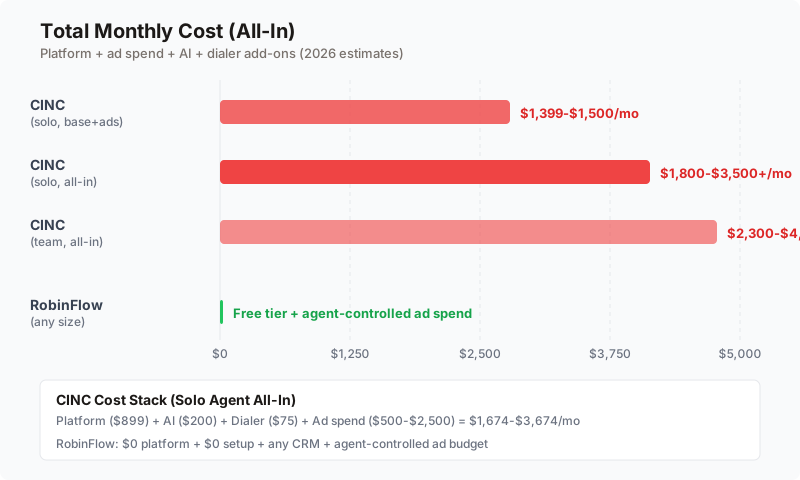
Total Cost of Ownership by Team Size
| Team Size | Platform + Ads + Add-Ons (Monthly) | Annual Investment |
|---|---|---|
| Solo agent (base + ads) | $1,399–$1,500 | $16,788–$18,000 |
| Solo agent (base + ads + AI + dialer) | $1,674–$1,775 | $20,088–$21,300 |
| Solo agent (realistic all-in) | $1,800–$3,500+ | $21,600–$42,000+ |
| Team (4 agents, realistic all-in) | $2,300–$4,500+ | $27,600–$54,000+ |
Source: Total cost ranges aggregated from Luxury Presence, 2026. "Realistic all-in" includes platform, recommended ad spend ($500–$2,500+), AI add-on, and dialer.
The math is straightforward: a solo agent paying $1,800/month invests $10,800 over 6 months before the platform is expected to produce closings. At $3,500/month, that's $21,000 before you see a return. CINC does offer a first-year money-back guarantee at the premium price point (AgentAdvice, 2026) — but you should confirm the exact terms, conditions, and qualifying criteria during your demo call before relying on it.
The ROI Timeline Problem
"Most agents need 3–6 months of consistent advertising and follow-up before lead generation produces closings" (Luxury Presence, 2026). This isn't unique to CINC — it's the reality of online lead generation. But the high monthly cost amplifies the risk. At $1,800/month, those 3–6 months represent $5,400–$10,800 in cash outflow with zero return. For a solo agent doing $150K GCI, that's 3.6–7.2% of gross income invested before the first CINC-sourced deal closes.
CINC's argument — and it's a fair one — is that the platform compounds: ads generate leads, leads fill your CRM, nurture sequences warm them over time, and the pipeline builds. By month 6–12, you should have a steady flow of conversion-ready leads. But that argument requires both the capital to sustain the investment and the confidence that seller leads specifically (not just buyer leads) will convert at a rate that justifies the cost.
Paying $1,800+/month for seller leads that arrive with no intent data?
RobinFlow captures seller timeline, motivation, and price expectations before the lead reaches your CRM. Free to start — no $899/month platform fee, no domain lock-in.
5. The Single Data Point Problem
This is the core issue with CINC's seller lead approach — and it's not unique to CINC. It applies to every platform that generates seller leads through home valuation pages.
When a homeowner completes a home valuation request on CINC, here's what you receive:
- Name
- Email address
- Phone number
- Property address
That's it. You know they were curious enough to request a valuation. You don't know if they're selling in 30 days or 3 years. You don't know why they want to sell. You don't know their price expectations. You don't know if they've already talked to another agent. SmartZip, a competing platform, makes the same criticism: "CINC provides leads based on a single data point: did the buyer or seller provide their information on a landing page? This is simply not enough information to understand whether a lead is truly interested and qualified" (SmartZip, 2026).
CINC AI attempts to solve this by texting and emailing leads to extract qualifying information after capture. But by then, the moment of peak interest has passed. The homeowner checked their home's value, got their number, and moved on with their day. Now an AI is trying to re-engage them — along with every other platform's AI and every other agent who captured the same intent signal.
The result is a high-volume, low-information lead flow that requires significant human effort to sort. Agents on review sites report the consequence: "Poor quality of leads, even though several hundred were received" and leads "far outside their target geography" (SmartZip, 2026). The volume looks impressive in a dashboard. The conversion rate tells a different story.
6. Contract Terms and Domain Ownership
CINC's contract terms are "order-form-specific" — meaning they vary by deal and aren't standardized on the website (Luxury Presence, 2026). This alone warrants scrutiny. A platform with standardized, transparent terms gives you something to review before the sales call. Order-form-specific terms mean you're negotiating in real time.
Two provisions in CINC's Terms & Conditions deserve particular attention:
- Domain ownership. CINC "reserves ownership of CINC-provided URLs, domain names, and domain registrations" (CINC Terms & Conditions, 2026). If you build your web presence on a CINC-provided domain, you leave it behind when you leave the platform. Every backlink, every Google ranking, every piece of SEO equity you built on that domain stays with CINC. Agents who bring their own domain through their registrar may have more portability — but the terms of site structure, content, and redirect transfers should be confirmed before signing.
- Cancellation terms. "Cancellation notice for contributors will be effective at the close of the then current billing cycle" (CINC Terms & Conditions, 2026). The practical implications depend on your specific order form — early termination fees, minimum commitment periods, and notice requirements should all be confirmed in writing before you sign.
Compare that to platforms offering month-to-month flexibility with no domain lock-in. If you run ads to a landing page on your own domain, every dollar of traffic builds an asset you control. If CINC isn't working by month three, you want the ability to pivot without losing your digital real estate.
7. RobinFlow: Purpose-Built for Seller Lead Capture
RobinFlow takes a fundamentally different approach to seller lead generation. Instead of running ads that generate high volumes of low-information leads and then using AI to sort through them, RobinFlow creates the mechanism for homeowners to tell you they want to sell — on their terms, with their specific details.
The Question-Flow System
RobinFlow provides branded landing pages built around multi-step question flows. When a homeowner visits your page — driven by your Facebook ads, Google ads, direct mail, social media, or organic search — they enter a guided experience that captures declared intent, not inferred interest. For a deep dive into why this conversion architecture works, see our Seller Lead Landing Pages guide.
A typical RobinFlow question flow collects:
- Property address and details — bedrooms, bathrooms, approximate condition
- Selling timeline — selling now, 3–6 months, just exploring
- Motivation — relocating, downsizing, upgrading, financial, life change
- Price expectations — what they think their home is worth
- Agent status — whether they've spoken to other agents
- Contact preferences — how and when they'd like to hear from you
By the time a homeowner completes the flow, you have a pre-qualified seller lead with actionable intelligence. You know their timeline. You know why they want to sell. You know their property. You know their expectations. Compare that to a CINC home valuation lead that gives you an address and a phone number — and the hope that CINC AI can extract the rest via text over days or weeks.
Multi-step question flows outperform single-page forms by 40–80% on conversion rate (RobinFlow Landing Pages guide, 2026). Each micro-commitment in the flow increases investment in completing the process. By the time homeowners reach the contact information step, they've already shared enough details that providing their phone number feels natural rather than invasive.
What You Know Before Your First Call
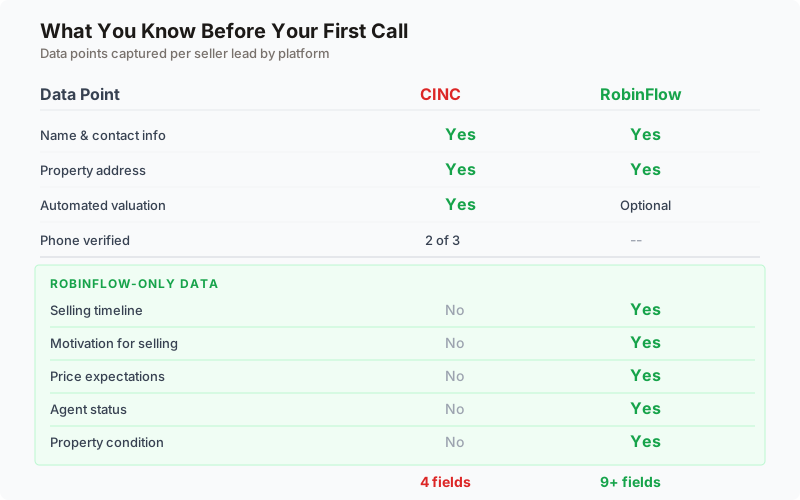
| Data Point | CINC Seller Lead | RobinFlow Seller Lead |
|---|---|---|
| Name and contact info | Yes | Yes |
| Property address | Yes | Yes |
| Automated home valuation | Yes (built-in AVM) | Optional (agent-controlled) |
| Selling timeline | No — CINC AI attempts to extract via text | Yes — captured in flow |
| Motivation for selling | No | Yes — captured in flow |
| Price expectations | No | Yes — captured in flow |
| Whether they have an agent | No | Yes — captured in flow |
| Contact preferences | No | Yes — captured in flow |
| Property condition | No | Yes — captured in flow |
With a RobinFlow lead, your first call can be: "Hi David, I see you're thinking about selling your 3-bedroom on Maple Drive in the next 3 months because you're relocating. You mentioned you think it's worth around $380K — I have some recent comps that support that range. When's a good time for me to walk through the property?"
With a CINC seller lead, your first call is: "Hi, I saw you requested a home valuation. Are you thinking about selling?" — and you're competing with every other agent whose home-valuation ad that homeowner also clicked that day.
Traffic Source Flexibility
CINC controls your traffic sources — their managed Google and Facebook campaigns drive traffic to their IDX websites. RobinFlow is traffic-source agnostic. Your question-flow landing pages accept traffic from any channel:
| Traffic Source | How It Works with RobinFlow | Typical Cost |
|---|---|---|
| Facebook/Instagram ads | Seller-focused ads → question-flow landing page | $15–$35/seller lead |
| Google PPC | "Sell my house [city]" keywords → landing page | $15–$60/seller lead |
| Direct mail + QR code | Postcards with QR code linking to your landing page | $1.50–$3.00/piece mailed |
| Organic social media | Link in bio, story swipe-ups, post CTAs | Free (time investment) |
| Email campaigns | Database nurture emails → landing page for active sellers | Free (existing database) |
| Yard signs + open houses | QR code on signage linking to question flow | Nearly free (existing activity) |
This matters because your lead cost is directly controlled by your channel choices — not locked to CINC's ad management algorithm. An agent running $500/month in Facebook ads to a RobinFlow page gets seller leads at $15–$35 each. That's competitive with CINC's $17.40 national seller CPL, with dramatically more data per lead. For a full breakdown of cost per lead by channel, see our Lead Generation Cost Comparison.
8. Day-in-the-Life: Working Seller Leads on Each Platform
To understand the practical difference, walk through a typical Tuesday morning for two agents — one using CINC, one using RobinFlow — who each have 5 new seller leads to work.
Agent A (CINC):
- 8:00 AM: Log into CINC CRM. Five new seller leads from yesterday's home valuation campaigns. Each has a name, email, phone, and property address. CINC AI has already sent initial texts to all five.
- 8:15 AM: Call lead #1. No answer. Leave voicemail: "Hi, I noticed you requested a home valuation for 456 Pine Street. I'd love to chat about what's happening in your neighborhood." This is the same message structure every CINC agent uses.
- 8:20 AM: Call lead #2. Answers. "Oh, I was just curious what my house was worth. I'm not really selling." You spend 8 minutes trying to qualify them. They're a tire-kicker — 3 years from listing, just checking equity. Tag them for a long-term nurture sequence.
- 8:30 AM: Call leads #3–5. One doesn't answer, one says they already have an agent, one is out of your target geography — they live 45 minutes away in a different market. The geographic mismatch is a known issue: agents report occasionally receiving "leads from far outside their target geography" (SmartZip, 2026).
- 8:45 AM: Total time spent: 30 minutes. Leads qualified: 0. Listing appointments: 0. You have one maybe — the tire-kicker in 3 years — and four dead ends. Cost for these 5 leads: $87 in CPL + your share of the $899/month platform fee.
Agent B (RobinFlow):
- 8:00 AM: Open your CRM. Five new seller leads from yesterday's Facebook ads driving to your RobinFlow question-flow page. Each has a name, phone, address, plus: selling timeline ("3–6 months"), motivation ("relocating for work"), price expectation ("$380K–$400K"), property condition ("good, minor updates needed"), agent status ("haven't talked to anyone yet"), and contact preference ("call in the morning").
- 8:05 AM: Sort by timeline. Two leads said "selling now," two said "3–6 months," one said "just exploring." Call the two "selling now" leads first.
- 8:10 AM: Call "selling now" lead #1: "Hi Maria, I see you're looking to sell your 3-bedroom on Oak Drive because you're relocating. You mentioned $390K — I pulled comps and that's right in range. Would Thursday afternoon work for a walkthrough?" Maria books the appointment. Call time: 4 minutes.
- 8:18 AM: Call "selling now" lead #2: No answer. Leave a voicemail referencing their specific situation: "I saw you're moving for work and looking to sell in the next few weeks. I have availability Thursday and Friday for a walkthrough — call me back at your convenience." The specificity signals you're not a generic robocaller.
- 8:25 AM: Queue the "3–6 months" leads for a nurture drip with market updates specific to their neighborhoods. Tag the "just exploring" lead for a quarterly check-in. Total time: 25 minutes. Leads qualified: 2 (both "selling now" with declared intent). Listing appointments booked: 1.
Same number of leads. Same morning. Dramatically different outcomes. The difference isn't the agents' skill — it's the data they started with. CINC's leads required qualification from scratch. RobinFlow's leads arrived pre-sorted by urgency, with context for a personalized first conversation.
9. Head-to-Head Comparison
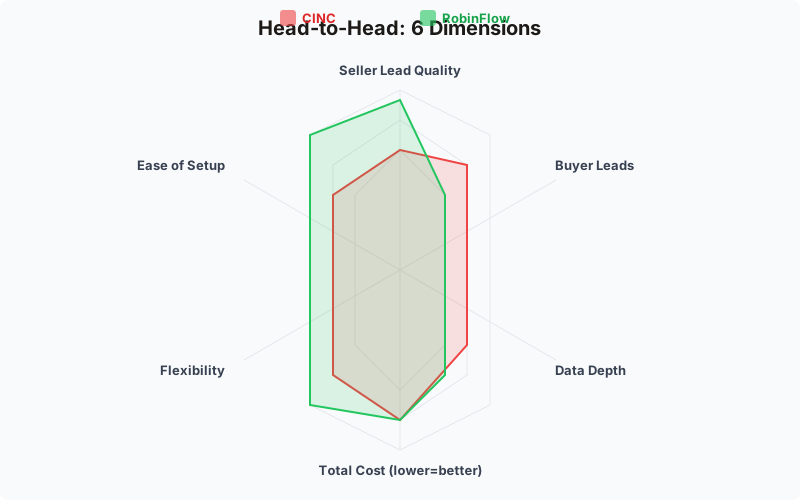
| Dimension | CINC | RobinFlow | Winner |
|---|---|---|---|
| Monthly cost (solo agent) | $1,800–$3,500+ all-in | Free platform + agent-controlled ad spend | RobinFlow |
| Seller lead CPL | $17.40 national avg (Google, Q4 2025) | $15–$35 (Facebook ads to question flow) | Comparable |
| Data points per seller lead | 4 (name, email, phone, address) | 9+ (adds timeline, motivation, price, agent status, condition, contact pref) | RobinFlow |
| Buyer lead capability | Strong — IDX sites, retargeting, managed PPC | Not the focus | CINC |
| CRM included | Yes — native CRM with routing, tagging, dialer | No — works with any CRM | CINC (convenience) |
| AI follow-up | CINC AI ($200/mo add-on) | Integrates with your existing tools | CINC (built-in) / RobinFlow (cost) |
| Contract flexibility | Order-form-specific; terms vary | No contracts | RobinFlow |
| Domain ownership | CINC retains CINC-provided domains | Agent owns everything | RobinFlow |
| Traffic source control | CINC-managed campaigns | Agent-controlled; any channel | Depends on preference |
| Time to first lead | Days (once ads are live) | Days (once ads drive traffic to page) | Comparable |
| Best for | Teams wanting managed buyer + seller lead gen | Listing-focused agents wanting seller intent data | — |
10. Where CINC Wins
This is not an "everything about CINC is bad" guide. Here's where CINC genuinely outperforms:
- Buyer lead generation at scale. If your primary need is high-volume buyer leads with managed ad campaigns, CINC's infrastructure is battle-tested across 50,000+ clients. The IDX websites, retargeting, and niche-targeting technology are purpose-built for buyer acquisition. CINC's Lead Value Index shows $13.98 in projected commission return per $1 of buyer ad spend (CINC LVI, Q1 2026). That's a compelling number for buyer-focused agents.
- All-in-one convenience. One platform, one login, one support team. No integrating five different tools. For team leads who don't want to manage a tech stack, CINC's integrated approach saves operational complexity.
- Phone verification. CINC's RealVerified system claims 2 of 3 leads actively verify their phone numbers. Reaching real people at real phone numbers is a genuine advantage over platforms where 30–40% of phone numbers bounce.
- Managed ad campaigns with proprietary targeting. CINC's niche-targeting technology analyzes which property types and campaign approaches work in your specific market. You're not guessing which ad creative to run — their $30M/year in managed spend gives them optimization data that a solo agent running their own ads doesn't have.
- Long track record. 15+ years in market, 50,000+ clients, and a G2 rating of 4.4/5 from 204 reviews. The platform works for many agents, particularly those focused on buyer leads.
11. The Saturation Factor
With 50,000+ agents on the platform, CINC faces the same saturation challenge as any large-scale lead generation platform. In competitive metros, multiple CINC agents are running similar managed campaigns, driving traffic to similar IDX websites, and their prospects are receiving similar automated messages from multiple agents simultaneously.
This hits seller leads harder than buyer leads. A buyer shopping for homes expects outreach from multiple agents. A homeowner who requested a home valuation doesn't expect to become a lead for five different agents in the same market — but that's effectively what happens when multiple CINC agents (and agents on Ylopo, BoldLeads, and other platforms) are all running home valuation campaigns in the same zip code.
The practical consequence: your effective cost per exclusive seller lead is higher than CINC's headline CPL suggests. If three agents in your market are running CINC seller campaigns, and a homeowner clicks all three valuation ads in the same search session, all three agents pay $17.40 for the same lead. Only one — at best — converts.
How to Check Before Signing Up
Before committing to CINC, ask the sales rep: "How many agents in my target zip codes are currently running seller campaigns through CINC?" If they deflect, search Google for "what is my home worth in [your city]" and count how many similar-looking home valuation ads appear. That number approximates your competition — not just from CINC, but from every platform running the same playbook.
12. Seller Lead Cost Per Closed Deal
Let's run the math on CINC's seller lead economics. These calculations use CINC's published CPL data and industry-standard conversion benchmarks from our Best Seller Lead Platforms Comparison:
| Metric | CINC Seller Leads | RobinFlow Seller Leads |
|---|---|---|
| Cost per seller lead | $17.40 (CINC Q4 2025 report) | $15–$35 (Facebook/Google to question flow) |
| Data points per lead | 4 (name, email, phone, address) | 9+ (with timeline, motivation, price, condition) |
| Platform cost on top of ad spend | $899–$1,174/mo (base + AI + dialer) | Free |
| Leads needed per listing appointment | 40–70 (home valuation leads, industry avg) | 10–20 (pre-qualified intent leads) |
| Monthly leads at $1,000 ad spend | ~57 leads | ~28–66 leads |
| Monthly listing appointments (est.) | 0.8–1.4 | 1.4–6.6 |
| Cost per listing appointment (platform + ads) | $1,350–$3,650 | $150–$700 |
Note: RobinFlow conversion estimates assume pre-qualified leads convert at 5–10% to listing appointments (vs 1.4–2.5% for unqualified home valuation leads). These are directional estimates — your actual conversion rates depend on your follow-up speed, market, and skills. For detailed methodology, see our Platform Evaluation Checklist.
The gap widens when you account for CINC's $899+/month platform fee on top of ad spend. A solo agent paying $1,800/month total (platform + ads) for ~57 seller leads per month needs to convert at 2.5% just to get one listing appointment — and at a cost of $1,800+ for that single appointment. A RobinFlow agent spending $500/month on Facebook ads (no platform fee) generating 14–33 pre-qualified seller leads needs the same 2.5% conversion rate to get a comparable appointment — but at a cost of $500.
See what pre-qualified seller leads look like
Build a branded question-flow landing page that captures seller intent — timeline, motivation, expectations — before your first call. Works with any CRM, any ad channel.
13. When to Choose CINC
CINC is the right choice when:
- You need both buyer and seller leads from one platform. CINC's buyer infrastructure is genuinely strong. If 70%+ of your business comes from buyer transactions and you want seller leads as a supplement, the combined platform makes sense.
- You run a team of 4+ agents and want managed lead distribution. CINC's lead routing, accountability dashboards, and team management features are designed for this. Solo agents are paying for team infrastructure they don't use.
- You want hands-off ad management. CINC's $30M/year in managed spend gives them optimization data most agents can't access independently. If running your own Facebook and Google ads sounds overwhelming, outsourcing to a platform with 15 years of data is a reasonable trade.
- Your budget is $2,000+/month and you can sustain it for 6+ months. CINC's ROI timeline requires capital reserves. Agents who can't sustain the investment through the ramp period shouldn't sign up.
- You're already generating buyer deals and want to add seller leads incrementally. The Seller Suite bolt-on makes more sense when buyer deals are already covering the platform cost.
14. When to Choose RobinFlow
RobinFlow is the right choice when:
- Your primary goal is winning listings. RobinFlow was built specifically for seller lead capture. Every feature — the question flow, the data collection, the pre-qualification — is designed to help you win listing appointments, not generate buyer traffic.
- You want seller intent data before your first call. Knowing a homeowner's timeline, motivation, and price expectations before you pick up the phone transforms your conversion conversation from cold qualification to warm consultation.
- You run your own ads (or work with a marketing agency). If you already manage Facebook or Google campaigns, RobinFlow adds a conversion layer that makes your existing spend more productive — without a $899/month platform fee on top.
- Budget flexibility matters. No contracts. No minimum commitments. Free to start. You control your ad spend directly.
- You want to own your digital assets. Your landing pages, your domain, your data. Nothing is lost if you change platforms.
- You're a solo agent or small team focused on listings. CINC's team infrastructure, managed ads, and buyer-side IDX features are overhead you don't need if your business is listings-first.
15. Can You Use Both?
Yes — and for some agents, the combined approach makes strategic sense. Here's how it works:
- CINC handles buyer leads. Let the platform do what it does best: run managed buyer campaigns, capture property search leads, and route them to your team through the CRM.
- RobinFlow handles seller leads. Run your own seller-focused ads (or use offline channels like direct mail and open house QR codes) driving to RobinFlow question-flow pages. Seller leads arrive pre-qualified with intent data.
- Your CRM connects both. CINC leads flow into its native CRM; RobinFlow leads flow into whatever CRM you choose. For agents using Follow Up Boss or similar, both sources can land in the same pipeline.
This approach lets you use CINC's buyer infrastructure (where it genuinely excels) without relying on its Seller Suite (where it's a secondary feature) for your listing pipeline. The additional cost is your RobinFlow ad spend — no platform fee — on top of your CINC subscription. For a deeper look at how to structure follow-up sequences for both lead types, see our Automated Follow-Up Sequences guide.
16. Common Objections — Addressed
"CINC has been around for 15 years. RobinFlow is newer."
True. CINC's longevity is a real credential — 15 years of operation and 50,000+ clients proves the platform works for many agents. But longevity doesn't mean it's the best tool for every job. CINC's 15 years were spent optimizing buyer lead generation. Its seller lead capabilities were added later as a secondary feature. RobinFlow was built seller-first from day one. The relevant question isn't which company is older — it's which tool was designed for the specific outcome you're chasing.
"CINC's managed ads save me time."
They do — and that has real value. Managing Google and Facebook campaigns takes time, knowledge, and ongoing optimization. CINC's $30M/year in managed spend gives them data advantages that a solo agent running their own campaigns can't match. If you genuinely don't want to touch ad management, CINC (or a similar managed platform) is a reasonable choice. The trade-off: you pay $899+/month for that convenience, and you give up control over targeting, budget allocation, and creative. If you already run ads for your business (many agents do), you're paying for capability you already have.
"I need buyer leads too, not just seller leads."
Most agents do. This is where the combined approach (§15) makes sense — or where you evaluate whether CINC's buyer leads are the best buyer leads available. Alternatives like Real Geeks ($399/mo, same parent company as CINC) deliver buyer leads at nearly half the monthly cost. Follow Up Boss ($69/user/mo) pairs with any lead source. The question is whether CINC's buyer lead infrastructure — specifically — is worth $500/month more than Real Geeks' buyer lead infrastructure. For many teams, the answer is yes (more ad spend data, more targeting sophistication). For budget-conscious solo agents, it may not be. See our CRM Comparison guide for more on mixing platforms.
"CINC has a money-back guarantee."
CINC offers a first-year money-back guarantee at the premium price point, which is a meaningful risk reduction (AgentAdvice, 2026). Before relying on it, confirm in writing: what exactly triggers the guarantee? Is it total lead volume? Conversion rate? Revenue? What documentation is required? What's the refund timeline? Guarantees are only as strong as their conditions — and conditions that are "discussed during the demo" rather than published on the website warrant extra scrutiny.
"$17.40 per seller lead is cheap."
Compared to what? It's competitive against other home valuation CPLs ($15–$35 range via Facebook, per industry benchmarks). But $17.40 per lead means nothing without knowing what that lead contains and what it converts to. At a 1–2% conversion rate (typical for home valuation leads), $17.40/lead becomes $870–$1,740 per listing appointment — before the $899/month platform fee. At 5–10% conversion (typical for pre-qualified intent leads), a $30/lead generates appointments at $300–$600 each with no platform fee on top. The "cheap" lead is often the expensive outcome.
17. ROI Calculation: What Each Platform Actually Costs Per Listing
Let's run a 12-month scenario for a solo agent who closes 3 CINC-sourced seller deals in a year (optimistic for a secondary feature on the platform) versus 3 RobinFlow-sourced seller deals.
| Cost Line Item | CINC (12 months) | RobinFlow (12 months) |
|---|---|---|
| Platform subscription | $10,788 ($899 × 12) | $0 (free tier) |
| CINC AI add-on | $2,400 ($200 × 12) | — |
| Dialer add-on | $900 ($75 × 12) | — |
| Ad spend (seller campaigns) | $6,000 ($500 × 12) | $6,000 ($500 × 12) |
| Total investment | $20,088 | $6,000 |
| Seller leads generated (at ~$17.40 / ~$25 avg CPL) | ~345 leads | ~171–400 leads |
| Listing appointments (at 1.5% / 6% conversion) | ~5 | ~10–24 |
| Deals closed (at 60% list-to-close) | ~3 | ~6–14 |
| Cost per closed seller deal | $6,696 | $429–$1,000 |
Assumptions: CINC seller conversion to appointment uses industry-average 1.5% for home-valuation leads. RobinFlow uses 6% for pre-qualified intent leads (mid-range of 5–10% benchmarks). Both use 60% appointment-to-close. Ad spend held equal at $500/mo for fair comparison. Your actual results depend on market, follow-up speed, and conversion skills.
At $6,696 per closed seller deal on CINC versus $429–$1,000 on RobinFlow, the math only works for CINC if buyer-side deals subsidize the investment. If you're closing 8–12 buyer deals per year through CINC (and many agents do), the total platform ROI may still be positive. But the seller-specific ROI is negative — you're paying more per seller listing than the seller side alone can justify. That's fine if you acknowledge it. It's a problem if seller leads are the primary reason you signed up.
18. The 50,000-Agent Question
CINC's scale is both its greatest strength and its most significant limitation for seller leads. With 50,000+ agents, the platform has more optimization data, more market coverage, and more infrastructure than nearly any competitor. That scale produces real advantages on the buyer side — lower CPLs, better targeting, more proven ad templates.
But for seller leads, scale creates a paradox: the more agents using CINC in your market, the more agents running the same home valuation campaigns to the same homeowners with the same automated follow-up. Every agent who joins your market on CINC makes your seller leads marginally less exclusive and marginally more expensive in practice.
RobinFlow's approach inverts this dynamic. Your question-flow landing page is yours — your brand, your questions, your domain. No other agent has the same page, the same flow, or the same data. Even if a homeowner completes question flows on two different agents' pages (unlikely, but possible), each agent receives genuinely differentiated information because the questions and branding are unique to them.
The takeaway isn't that CINC is bad — it's that the value equation depends on what you're solving for. CINC optimizes for scale, convenience, and buyer lead volume. RobinFlow optimizes for seller lead depth, agent ownership, and cost efficiency. They're answering different questions.
There's a deeper structural issue worth naming. CINC's business model incentivizes lead volume — more leads mean more ad spend flowing through the platform, which is how CINC gets to $30M in annual managed spend. Your success metric (listings closed) and CINC's success metric (ad spend processed) aren't perfectly aligned. That misalignment isn't malicious — it's structural. When a platform generates revenue proportional to how many leads it produces rather than how many deals you close, the incentive is always to generate more leads, not better leads.
RobinFlow's model inverts this: you control your own ad spend, and the platform's value is measured by the quality of the capture — how much data each lead contains, how effectively the question flow pre-qualifies, and how quickly you can convert. The platform succeeds when your first call produces a result, not when your dashboard fills with volume.
19. Decision Framework
Answer these five questions to determine which platform fits your business:

- Is your primary lead need buyer or seller?
- Buyer-focused → CINC's buyer infrastructure is proven and scalable.
- Seller-focused → RobinFlow captures the intent data that home valuation pages miss.
- Both → Consider the combined approach (§15).
- What's your monthly budget?
- $2,000+/month with 6+ month runway → CINC is financially viable.
- Under $2,000/month → CINC's base + ads will stretch your budget thin. RobinFlow + self-managed ads gives you seller leads without the platform overhead.
- Solo agent or team?
- Team (4+ agents) → CINC's routing, dashboards, and managed services add operational value.
- Solo or small team → You're paying for team infrastructure you don't use on CINC.
- Do you want managed ads or self-managed?
- Managed → CINC handles everything. Your time goes to conversion, not campaign management.
- Self-managed → RobinFlow gives you the conversion layer without paying for ad management you do yourself.
- How important is contract flexibility?
- Want month-to-month → RobinFlow. No contracts, no lock-in, no domain risk.
- Comfortable with commitment → CINC's order-form terms are negotiable; ask for favorable cancellation terms before signing.
20. FAQ
How much does CINC cost per month in 2026?
CINC starts at $899–$1,000/month for solo agents and $1,299–$1,500/month for teams. With recommended ad spend ($500+/mo), CINC AI ($200/mo), and dialer ($75/mo), realistic all-in costs are $1,800–$3,500+/month. Annual investment ranges from $21,600 to $42,000+ (Luxury Presence, 2026).
Is CINC good for seller leads?
CINC generates seller leads through home valuation pages and cash offer ads, with a national Google seller CPL of $17.40 in Q4 2025 (CINC, Q4 2025). The CPL is competitive, but seller leads arrive with minimal qualifying data (name, email, phone, address). CINC was built buyer-first — the Seller Suite is a secondary feature, not the platform's core strength.
What's the difference between CINC and RobinFlow?
CINC is an all-in-one platform with managed ads, IDX websites, and a native CRM, optimized for high-volume buyer lead generation with seller leads as a secondary capability. RobinFlow is purpose-built for seller lead capture through multi-step question flows that collect timeline, motivation, and price expectations before the lead reaches your CRM. CINC optimizes for volume and convenience; RobinFlow optimizes for seller data depth and cost efficiency.
Can I cancel CINC at any time?
CINC's contract terms are order-form-specific and vary by deal. "Cancellation notice for contributors will be effective at the close of the then current billing cycle" (CINC Terms, 2026). Confirm the specific commitment period, early termination fees, and cancellation notice requirements in writing before signing.
Does CINC own my website domain?
CINC "reserves ownership of CINC-provided URLs, domain names, and domain registrations" per its Terms & Conditions (CINC, 2026). If you use a CINC-provided domain, you lose access when you leave the platform. Agents who bring their own domain through their registrar may retain more portability — confirm the specifics before signing.
Is CINC worth $899/month for a solo agent?
It depends on your primary need. For buyer leads with managed ad campaigns, CINC's proven infrastructure can justify the cost if you can sustain the 3–6 month ramp-up. For seller leads specifically, $899/month pays for a platform whose seller capabilities are a secondary feature. Compare: $500/month in self-managed Facebook ads driving to a RobinFlow question-flow page generates pre-qualified seller leads with intent data — at a fraction of the total cost.
21. The Bottom Line
CINC is a proven, well-established platform with strong buyer lead generation infrastructure. Its 50,000+ clients, $30M in annual managed ad spend, and 15+ years of operation are genuine credentials. If you're a team leader running buyer-focused operations and want managed everything, CINC delivers real value — particularly on the buyer side.
But if your primary goal is winning listings, CINC's Seller Suite is a secondary feature on a buyer-first platform. You're paying $899+/month for a system optimized for buyer lead acquisition and using its seller capabilities as a bolt-on. The seller leads arrive with minimal data (4 fields), require AI and human effort to qualify after capture, and cost $17.40+ each before you add the platform fee.
RobinFlow inverts the equation: purpose-built for seller leads, free to start, no contracts, agent-owned assets, and 9+ data points captured at the moment of peak homeowner interest. Your first call is a consultation, not a cold qualification. Your lead cost is your ad spend — no platform markup.
The best decision isn't CINC or RobinFlow — it's the right tool for the right job. Use CINC for buyer leads if that's a core revenue stream. Use RobinFlow for seller leads where data depth and conversion efficiency matter more than volume. And whichever path you choose, measure cost per listing appointment — not cost per lead, not impressions, not total volume. That's the number that determines whether the investment pays for itself.
If you're an agent or team lead evaluating CINC right now, here's the most productive thing you can do: run a 90-day test with both. Use CINC for buyer leads (it's genuinely strong there). Simultaneously, run $500/month in seller-focused Facebook ads to a RobinFlow question-flow page. At the end of 90 days, compare: how many listing appointments came from CINC seller leads versus RobinFlow seller leads? What was your cost per appointment from each source? What was the data quality difference in your first conversations? Let the data tell you which tool earned its place in your stack — and which one is paying for capabilities you don't need.
Ready to start capturing seller intent? RobinFlow is free to start — build a branded question-flow landing page, connect your CRM, and start generating pre-qualified seller leads before your next ad dollar is spent. Get started here.
For related reading: our Real Estate CRM Comparison covers how CINC's native CRM stacks up against Follow Up Boss, Sierra Interactive, and others. Our RobinFlow vs Offrs & SmartZip guide compares predictive analytics approaches. And our Home Valuation Funnel guide breaks down how to build high-converting valuation pages on your own domain.
Ready to capture seller intent instead of sorting through volume?
Launch a branded question-flow landing page, pre-qualify sellers automatically, and get leads who already told you they want to sell.
Get Started Free