
Real Estate Farming: How to Pick, Launch, and Dominate a Farm Area
66% of sellers hire an agent they already know. Geographic farming is how you become that agent — systematically, predictably, and at scale. This is the complete system for choosing your territory, running multi-channel outreach, and building a digital capture layer that converts awareness into listings.
1. Why Farming Still Beats Every Other Lead Source — and It's Not Close
Here's the math most agents never do: 66% of sellers choose their agent through a referral or a prior relationship, according to NAR's 2025 Profile of Home Buyers and Sellers. Another 37% were specifically referred by a friend, neighbor, or relative. That means the majority of listing business goes to the agent who is already known, already trusted, and already top-of-mind when a homeowner decides to sell.
Geographic farming is how you become that agent — systematically, predictably, and at scale. Instead of chasing cold leads across an entire metro area, you concentrate your marketing, prospecting, and community involvement on a defined geographic territory — typically 500 to 1,000 homes — until your name is the first one that comes up at the kitchen table.
The numbers back this up at every level. Agents who have farmed a neighborhood for two or more years consistently report that organic referrals and repeat business reduce their reliance on paid lead sources. Top producers who commit to farming capture 30% to 50% of available listings in their territory after sustained effort. And with NAR projecting existing-home sales to surge 14% in 2026, agents positioned as the local expert in a defined area are set to capture a disproportionate share of that inventory.
The reason farming outperforms portal leads, paid ads, and even sphere-of-influence marketing over time is compounding. Every postcard, every door knock, every community event, every sold sign in the neighborhood adds another layer of recognition. Portal leads start at zero trust every time. A farming lead already knows your name, has seen your postcards, and watched you sell their neighbor's house. That lead converts at a fundamentally different rate.
2. How to Pick a Farm Area: The Selection Framework That Prevents Expensive Mistakes
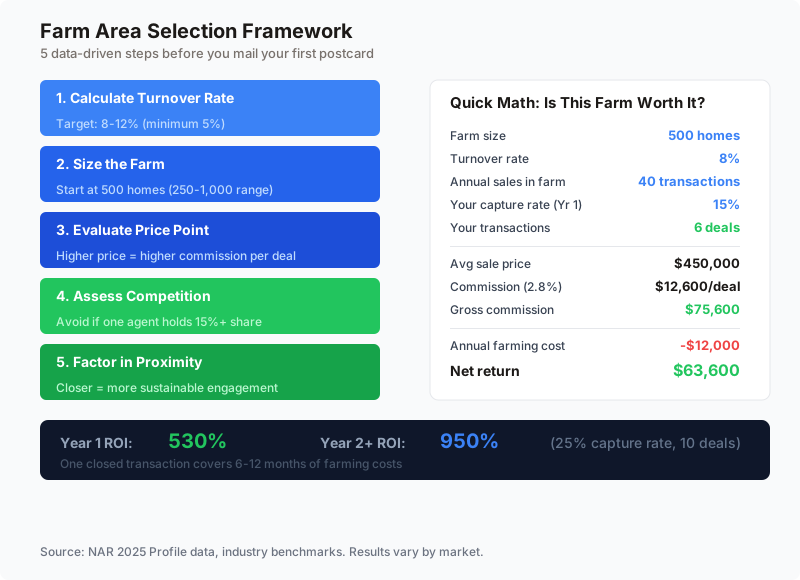
Choosing the wrong farm is the most expensive mistake an agent can make in this strategy — not because of the money lost on mailers, but because of the 6-12 months of effort invested before you realize the area can't support your goals. Here's the systematic framework for selecting a farm that works.
Step 1: Calculate the Turnover Rate
The turnover rate is the single most important number in farm selection. It tells you how frequently homes sell in an area, which directly determines how many listing opportunities exist each year.
| Turnover Rate | Assessment | What It Means for Your Farm |
|---|---|---|
| Below 5% | Too low | Not enough transactions to justify the marketing investment — look elsewhere |
| 5-7% | Acceptable | Viable if the average price point is high enough to compensate for fewer deals |
| 8-12% | Ideal | Sweet spot — enough transactions to generate consistent income with manageable competition |
| Above 12% | High activity | Strong opportunity, but often comes with more agent competition — evaluate before committing |
The formula is straightforward: Turnover Rate = (Number of homes sold in the last 12 months) / (Total number of homes in the area). Use RPR (Realtors Property Resource), which is free for NAR members, or pull the data from your MLS. Count only residential sales — exclude commercial, land, and new construction unless your farm specifically includes those property types.
Step 2: Size the Farm Correctly
Farm size determines both your opportunity ceiling and your marketing budget floor. Too small and you can't generate enough transactions. Too large and you can't maintain the consistency that makes farming work.
| Farm Size | Monthly Mail Cost | Expected Annual Transactions (at 8% turnover, 20% capture) | Best For |
|---|---|---|---|
| 250 homes | $260-$375 | 4 transactions | New agents starting their first farm or testing a concept |
| 500 homes | $520-$750 | 8 transactions | The optimal starting point for most agents — manageable budget, meaningful volume |
| 750 homes | $780-$1,125 | 12 transactions | Established agents ready to scale their farming investment |
| 1,000 homes | $1,040-$1,500 | 16 transactions | Teams or high-producing agents with proven farming systems |
Start at 500 homes. This gives you enough transactions to generate meaningful income while keeping your budget under $750/month for mail alone. If your target neighborhood is larger than 500 homes, select a section of it — you can always expand once the first section is producing. The agents who fail at farming almost always started too big, spread their budget too thin, and quit after 6 months without results.
Step 3: Evaluate the Price Point
Your farming costs are the same whether the average home in your farm sells for $300,000 or $600,000 — same postcard, same stamp, same door knock. But your commission per transaction doubles. If you're choosing between two neighborhoods with similar turnover rates, choose the one with the higher average sale price every time. A $500K average price at 3% commission means each deal is worth $15,000. A $350K average means $10,500. Over 8 transactions, that's a $36,000 annual difference from the same farming effort.
Step 4: Assess the Competition
Pull the last 24 months of closed sales in your target area and sort by listing agent. If one agent has 15% or more of the listings, that farm is dominated — you'll be fighting an uphill battle against an established brand with deep roots. Look for areas where no single agent holds more than 10% share. Fragmented competition means homeowners haven't bonded with any particular agent, which creates the opening you need.
One exception: if the dominant agent is retiring, scaling back, or has poor marketing (no digital presence, outdated postcards, no follow-up system), you can enter their farm and take share. But you need a clear strategy for why homeowners should switch their loyalty.
Step 5: Factor in Proximity and Personal Connection
The closer your farm is to where you live or work, the more sustainable your effort will be. You'll drive the streets naturally, notice when a neighbor starts packing, attend the same local events, and have authentic knowledge of the area. Agents who farm their own neighborhood have the ultimate advantage — they're not just marketing to the area, they live there. If you can't farm your own neighborhood (wrong price point, wrong turnover rate, or another agent dominates it), choose the closest viable alternative.
3. The Multi-Channel Farming System: Mail + Knock + Digital + Community
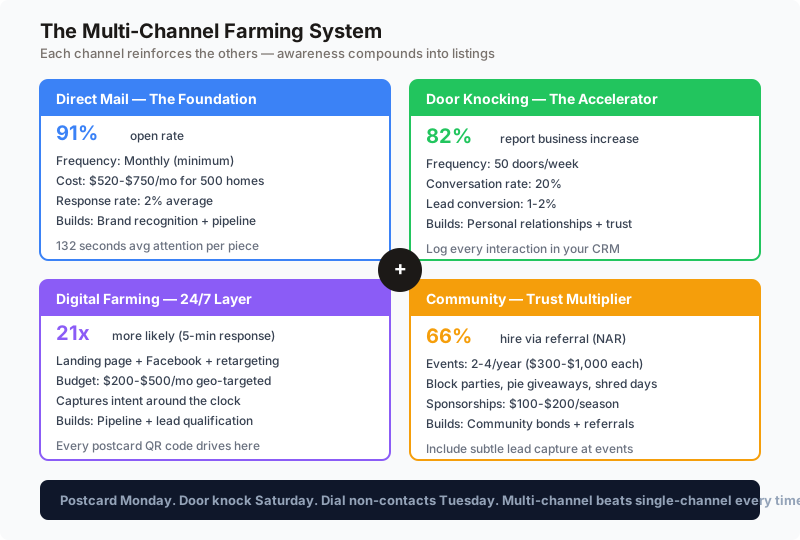
The agents winning with farming in 2026 aren't relying on a single channel. They're running a coordinated multi-channel system where each touchpoint reinforces the others. A homeowner sees your postcard on Monday, your Facebook ad on Wednesday, you at their door on Saturday, and your market report in their email on Sunday. That's not four separate impressions — it's one cohesive brand experience.
Here's the complete system, broken down by channel.
Channel 1: Direct Mail — The Foundation
Direct mail is the anchor of any farming strategy because of one stat that digital marketers hate: physical mail gets a 91% open rate, compared to 20-30% for email. A postcard holds a homeowner's attention for an average of 132 seconds. Your email gets 11 seconds if you're lucky.
The minimum viable frequency is one piece per month to your entire farm. Anything less and you lose the consistency that makes farming work. Here's what to send:
| Month | Mailer Type | Purpose |
|---|---|---|
| January | Market Prediction / Year Ahead | Establish authority with forward-looking data |
| February | Home Valuation Offer | Lead generation — drive homeowners to your landing page |
| March | Spring Market Update | Seasonal relevance — spring is peak listing season |
| April | Just Sold / Case Study | Social proof — show you're actively selling in the area |
| May | Neighborhood Stats Report | Hyper-local data positions you as the neighborhood expert |
| June | Home Valuation Offer | Second lead gen push — catch summer sellers |
| July | Community Event Invite | Build personal connection beyond transactions |
| August | Back-to-School / Fall Preview | Seasonal content with market tie-in |
| September | Fall Market Update | Capture fall listing wave with timely data |
| October | Just Sold / Case Study | Second round of social proof |
| November | Home Valuation Offer | Third lead gen push — catch year-end sellers |
| December | Holiday / Year in Review | Warm, personal touch — high retention |
The key principle: alternate between lead generation pieces (home valuation offers that drive to your landing page) and brand-building pieces (market updates, just solds, community content). Lead gen without brand is cold outreach. Brand without lead gen is awareness without pipeline. You need both.
Channel 2: Door Knocking — The Accelerator
Door knocking produces results that digital channels can't replicate. Agents who door knock report a 1-2% conversion to lead and a 20% conversation rate — multiples higher than cold-call benchmarks. And 82% of agents who knock doors consistently report a measurable increase in business.
The door knock script for farming is different from prospecting scripts. You're not selling — you're building a relationship with someone you'll see again next month and the month after that. Here's what works:
The Farming Introduction: "Hi, I'm [Name] — I'm a local agent and I've been sending you market updates for the neighborhood. I'm stopping by to put a face to the name and drop off [a market report / a seasonal gift / a local business guide]. Is there anything real estate-related I can help with, even if it's just a question about your home's value?"
The goal of every door knock is not a listing appointment — it's a conversation. You want to learn who lives there, how long they've been there, and whether they have any real estate needs (selling, buying for a family member, knowing a neighbor who might be moving). Over time, these conversations compound into relationships that produce referrals.
Knock 25-50 doors per session. Block out a 2-3 hour window on a Saturday morning, bring a stack of market reports, and work a section of your farm. Over the course of 3-4 months, you'll have knocked every door at least once. Keep notes in your CRM on every conversation.
Channel 3: Digital Farming — The 24/7 Layer
Physical farming has a limitation: it only works when you're actively doing it. Your postcard sits on the counter for a few days. Your door knock happens once a quarter. But a homeowner's moment of curiosity — "I wonder what my house is worth" — can happen at 11 PM on a Tuesday. That's where digital farming fills the gap.
A complete digital farming layer includes:
- Branded landing page — A dedicated home valuation page with your branding that captures homeowner information when they want to know their home's value. Every postcard, every door hanger, every ad should drive to this page.
- Geotargeted Facebook/Instagram ads — Run ads targeted specifically to your farm's ZIP code or neighborhood. Budget as little as $200-$500/month. The ad content should mirror your mailer themes — market updates, home valuations, just sold results.
- Retargeting campaigns — When someone visits your landing page but doesn't fill out the form, retarget them with display ads across the web. This keeps your name in front of warm prospects.
- Email/SMS nurture sequences — Every lead captured through your digital funnel enters an automated follow-up sequence. Market updates, neighborhood news, and gentle calls-to-action delivered on autopilot.
- Social media presence — Post neighborhood-specific content on Facebook and Instagram. Tag locations, highlight local businesses, share sold results. Nextdoor is particularly valuable for farming agents — it's organized by neighborhood, which is exactly how you think about your business.
The magic happens when physical and digital work together. A homeowner receives your postcard with a QR code linking to your home valuation page. They scan it at 9 PM, enter their address, and you have a warm lead by morning. You follow up with a call that references both the postcard and their valuation request. That's not a cold call — that's a conversation with someone who already knows your name and has engaged with your process.
4. Building Your Digital Capture Layer: The Technology That Farms While You Sleep
Most farming guides stop at postcards and door knocking. That's incomplete. In 2026, homeowners research their home's value online months before they talk to an agent. If you don't have a digital capture mechanism in place, those homeowners in your farm — the ones you've been mailing to for months — will Google "home value" and land on Zillow instead of your page.
The digital capture layer has four components:
Component 1: The Branded Home Valuation Landing Page
This is your farm's 24/7 lead capture system. A dedicated page — branded with your name, your photo, and your farm area — that offers homeowners a free estimate of their home's value. The page collects their address, name, email, and phone number, and ideally asks a few qualifying questions about their timeline and motivation.
Every physical touchpoint in your farm should drive to this page:
- QR code on every postcard linking to the landing page
- URL printed on every door hanger and market report
- Facebook ads targeted to your farm that click through to the page
- Business card URL customized to the page
The landing page converts passive awareness ("I see this agent's postcards every month") into active pipeline ("This homeowner wants to know what their house is worth"). That conversion is the entire point of farming — and without a digital capture mechanism, it happens on someone else's website.
Component 2: The Question Flow
A simple form that asks for an address captures a lead. A question flow that asks about timeline, motivation, and property condition captures a qualified lead. The difference matters. When a homeowner tells you they're thinking about selling in the next 6 months because they're relocating for work, that's actionable intelligence that shapes your follow-up. When all you have is an address and email, you're guessing.
Effective question flows are short (4-6 questions), progressive (easy questions first, contact info last), and value-driven (the homeowner gets something useful — a valuation, a market report — in exchange for their information).
Component 3: The CRM Integration
Leads from your digital capture layer need to flow directly into your CRM with proper tagging. Tag every lead with the farm area, the source (postcard QR, Facebook ad, direct visit), and the qualification level (timeline, motivation). This allows you to segment your follow-up — a homeowner who's thinking about selling in 3 months gets a different sequence than one who's just curious about their value.
Speed matters enormously here. Studies show that leads contacted within the first 5 minutes are 21 times more likely to convert than leads contacted after 30 minutes. An automated text or email triggered the moment a homeowner submits your form — "Thanks for checking your home's value, [Name]. I'm [Your Name], the local expert in [Neighborhood]. I'll have your detailed report ready within 24 hours. Is there anything specific about the market you'd like to know?" — dramatically increases your conversion rate.
Component 4: The Automated Follow-Up Sequence
Not every homeowner who checks their value is ready to sell today. Most aren't. But 80% of real estate sales require 5 or more follow-up contacts. Your automated follow-up sequence keeps you in front of those homeowners without requiring manual effort for every touch.
A strong follow-up sequence for farming leads:
| Timing | Channel | Content |
|---|---|---|
| Immediately | Text/Email | Acknowledgment + set expectations for detailed report |
| Day 1 | Detailed valuation report with 3-4 comparable sales | |
| Day 3 | Phone call | Personal follow-up — ask if they have questions about the report |
| Week 2 | Neighborhood market update with recent activity | |
| Month 1 | New comparable sale or market trend affecting their area | |
| Monthly ongoing | Automated market updates — they're also getting your monthly mailer | |
| Quarterly | Phone/Door knock | Personal check-in — you're already in the neighborhood |
Your farm needs a digital capture layer
RobinFlow gives your farm a branded home valuation page that captures homeowner interest 24/7 — so your postcards and door knocks convert into qualified leads, not just awareness.
5. The 12-Month Farming Launch Plan: Month by Month
Farming fails when agents improvise. It succeeds when agents follow a plan. Here's the complete 12-month launch sequence for a new farm, assuming a 500-home territory.
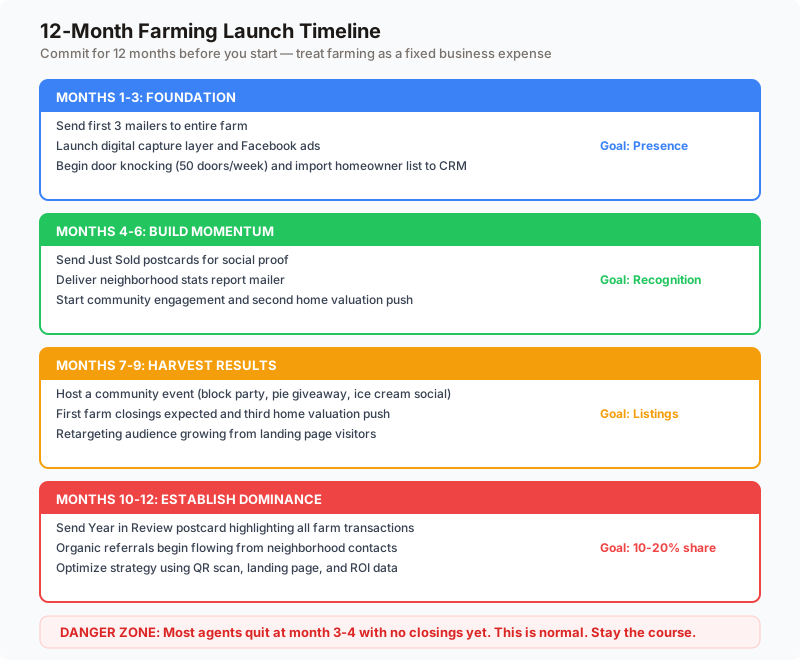
Months 1-3: Foundation
The first three months are about establishing your presence — not generating listings. Adjust your expectations accordingly. You're planting seeds.
- Month 1: Send your first mailer — an introduction postcard with your photo, a market snapshot, and a QR code to your home valuation page. Set up your digital capture layer. Run initial Facebook ads targeted to your farm's ZIP code. Pull the full list of homeowners from your MLS or a data provider.
- Month 2: Send a market update mailer with hyper-local stats. Begin door knocking — aim for 50 doors per weekend. Log every conversation in your CRM. Continue Facebook ads.
- Month 3: Send a home valuation offer postcard. This is your first aggressive lead-gen piece. Track how many homeowners scan the QR code or visit your landing page. Continue door knocking a new section of the farm.
Months 4-6: Build Momentum
By month 4, homeowners have seen your name 3-4 times. Recognition is building. Now layer in community engagement and social proof.
- Month 4: If you've closed or listed anything in the farm, send a Just Sold postcard. If not, send a case study from a nearby area. Social proof signals activity. Start attending or hosting a neighborhood event — a casual meet-up, a charity drive, sponsoring a local team.
- Month 5: Send a neighborhood-specific stats report — average prices, days on market, inventory levels, year-over-year trends. Position this as an exclusive report "for residents of [Neighborhood]." Continue door knocking and digital ads.
- Month 6: Second home valuation offer mailer. By now, the homeowners who are curious about their value have seen your name enough to trust your landing page. Conversion rates on this piece should be measurably higher than month 3.
Months 7-9: Harvest Early Results
Months 7-9 are when farming typically starts producing. Not because of anything you did in month 7, but because of the cumulative effect of 6 consistent months of presence.
- Month 7: Host a community event — a neighborhood block party, a pie giveaway, an ice cream social, a holiday-themed gathering. Invite the entire farm. This is the highest-impact single activity you can do. The agents who host memorable events become legends in their farm area.
- Month 8: Send a fall market update. By now, you should have closed at least one transaction in the farm (statistically, an 8% turnover rate on 500 homes = 40 sales/year = ~3.3/month). Use that closed sale in your marketing.
- Month 9: Third home valuation push. Pair this with a fresh round of geotargeted digital ads. Your retargeting audience should be growing — every landing page visitor who didn't convert is seeing your display ads across the web.
Months 10-12: Establish Dominance
By the end of year one, your goal is to have captured 10-20% of the listings in your farm. That's the threshold where farming becomes self-sustaining — referrals start coming in organically, homeowners call you before they call anyone else, and your name is the default answer to "do you know a good agent?"
- Month 10: Send a Just Sold / Year in Review piece highlighting every transaction you've done in the area. Social proof is cumulative — a postcard showing 4-6 sold signs in the neighborhood is powerful.
- Month 11: Final home valuation push of the year. Review your landing page conversion data — which mailer themes drove the most scans? Which Facebook ad creative performed best? Use this data to plan year two.
- Month 12: Holiday card or year-end community piece. Warm, personal, not salesy. This is the piece homeowners put on their fridge. Include a small gift if budget allows — a local business gift card, a calendar, a recipe card.
6. Budget Planning: What Farming Actually Costs and What It Returns
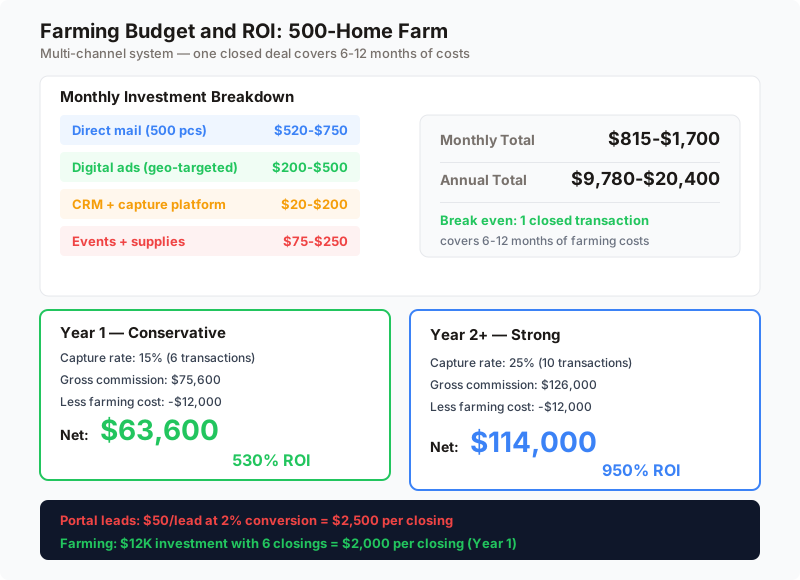
Let's get specific about money. Vague budgets lead to vague results. Here's the complete cost breakdown for farming a 500-home area with a multi-channel system.
| Expense Category | Monthly Cost | Annual Cost | Notes |
|---|---|---|---|
| Direct mail (500 pieces/month) | $520-$750 | $6,240-$9,000 | Postcards at $1.04-$1.50 each including postage |
| Geotargeted digital ads | $200-$500 | $2,400-$6,000 | Facebook/Instagram + Google retargeting |
| Digital capture platform | $0-$100 | $0-$1,200 | Home valuation landing page and lead capture |
| CRM | $20-$100 | $240-$1,200 | Follow Up Boss, kvCORE, Wise Agent, etc. |
| Community events (2-4/year) | $50-$200 | $600-$2,400 | Food, supplies, venue costs spread across the year |
| Door knocking supplies | $25-$50 | $300-$600 | Market reports, door hangers, small gifts |
| Total | $815-$1,700 | $9,780-$20,400 |
The ROI Calculation
Now look at the return side. Assume a 500-home farm with 8% turnover (40 sales/year) and a modest 15% capture rate in year one (6 transactions). At a $450,000 average sale price and 2.8% listing commission:
| Metric | Conservative (Year 1) | Strong (Year 2+) |
|---|---|---|
| Capture rate | 15% (6 transactions) | 25% (10 transactions) |
| Average commission per deal | $12,600 | $12,600 |
| Gross commission income | $75,600 | $126,000 |
| Annual farming investment | $12,000-$15,000 | $12,000-$15,000 |
| Net return | $60,600-$63,600 | $111,000-$114,000 |
| ROI | 404-530% | 740-950% |
Even the conservative year-one scenario delivers a 4-5x return. And the real advantage is year two and beyond, when your capture rate climbs because homeowners already know you, referrals start flowing, and you've built a sold history in the area that makes your postcards even more compelling.
Compare this to portal leads, where agents routinely report paying $30-$80 per lead with a 1-3% conversion rate. At a $50 average cost per lead and 2% conversion, you need 50 leads ($2,500) to close one deal. Your farming system generates leads at a fraction of that cost — and the leads are warmer because the homeowner already knows who you are.
7. Direct Mail That Actually Works: Postcard Strategy for Farming Agents
Most farming postcards get thrown away because they look like every other agent's postcard — generic headshot, generic slogan, generic market stats. Here's how to create mail pieces that homeowners actually read and respond to.
The Anatomy of a High-Performing Farming Postcard
The average farming postcard gets a 2% response rate. That means 10 out of 500 homeowners will take an action — visiting your website, calling you, or scanning your QR code. To hit that benchmark (and exceed it), every postcard needs five elements:
- Hyper-local headline. "Your Home on Elm Street May Be Worth More Than You Think" outperforms "Thinking About Selling?" by a wide margin. Use the neighborhood name, the street name, or a specific local reference. Generic headlines get generic results.
- One clear call-to-action. Don't ask the reader to visit your website AND call you AND email you AND follow you on Instagram. One action: scan this QR code to see your home's estimated value. That's it.
- Social proof. A "Just Sold" postcard showing the address, sale price, and days on market is the highest-performing farming piece you can send. If you haven't sold anything in the farm yet, use a sold result from a nearby area with a headline like "Sold in 9 Days — Is Your Home Next?"
- Professional design. Use a template from a dedicated real estate mail provider (Wise Pelican, Corefact, ProspectsPLUS!) rather than designing from scratch. These companies have tested thousands of designs and know what gets response. Spend your energy on copy, not layout.
- QR code linked to your capture page. Every single postcard should include a QR code that takes the homeowner directly to your home valuation landing page. Not your website homepage. Not your brokerage page. Your dedicated capture page with a form that captures their information.
Postcard Types Ranked by Effectiveness
| Postcard Type | Primary Purpose | When to Send | Expected Response |
|---|---|---|---|
| Just Sold | Social proof | Within 2 weeks of closing | Highest engagement — proves you're active in the area |
| Home Valuation Offer | Lead generation | Quarterly | Highest lead capture — drives traffic to your landing page |
| Market Update | Authority building | Monthly or quarterly | Moderate — builds expert positioning over time |
| Community/Seasonal | Brand warmth | Holidays or events | Lowest direct response, highest long-term retention |
Rotate through these types on a monthly basis. The mix matters: lead gen pieces (home valuation offers) generate pipeline, but they only work because brand-building pieces (market updates, community content) have established trust. Sending nothing but "What's your home worth?" mailers every month will burn out your farm. The sequence is brand → brand → lead gen → brand → social proof → lead gen.
8. Door Knocking for Farming: Scripts, Timing, and the Long Game
Door knocking in a farm area is fundamentally different from prospecting door knocking. You're not trying to get a listing appointment from a cold contact. You're building a relationship with someone you'll see again next month. The goal is recognition and trust, not a signature.
The Farming Door Knock Script
Keep it simple. Over-scripted approaches feel rehearsed and create resistance. Here's the framework that works:
Opening: "Hi, I'm [Name] — I'm a local real estate agent who specializes in [Neighborhood]. I've been sending you market updates and I wanted to put a face to the name."
Value offer: "I brought a quick market snapshot for [Neighborhood] — shows what's sold recently and what the trends look like. [Hand them the report.] No strings attached."
Conversation starter: "How long have you been in the neighborhood? Are you seeing a lot of changes around here?"
Soft close: "If you ever have any questions about real estate — whether it's your home's value, a renovation question, or even a recommendation for a contractor — I'm always happy to help. I'm right down the street."
If they mention selling: "That's great — I'd love to give you a detailed look at what comparable homes in the area have sold for recently. I can put together a report and walk you through it. Would this week or next work better?"
Timing and Logistics
Saturday mornings (9 AM - 12 PM) are the highest-contact window for door knocking. Homeowners are home, awake, and not yet busy with the day's activities. Avoid weekday evenings — people are tired and less receptive. Sunday mornings are also effective, particularly in family-oriented neighborhoods.
Knock 25-50 doors per session. Bring a stack of market reports, a few small items (pens with your branding, local business discount cards), and your phone for taking notes. After each conversation, immediately log the details in your CRM: name, how long they've lived there, any real estate interest, and any personal details (kids' names, dog's breed, renovation projects) that make future conversations feel personal.
The agents who fail at door knocking make two mistakes: they treat it as a one-time event instead of a recurring habit, and they don't track their interactions. Knocking 50 doors once is prospecting. Knocking the same 50 doors every quarter, each time referencing your last conversation, is farming. The distinction is everything.
Handling Common Responses
| Response | Your Reply |
|---|---|
| "Not interested" | "No worries at all — I just wanted to drop off this market report and introduce myself. If anything ever comes up, I'm right in the area." |
| "We already have an agent" | "That's great — it's smart to have a good relationship with someone you trust. I'll still keep sending you the market updates so you're always informed." |
| "We're not selling" | "I hear that all the time — and honestly, most of my clients weren't planning to sell when we first met. I'm just here to be a resource whenever you need one." |
| No answer | Leave a market report in a door hanger bag. They'll see your name and face, reinforcing the brand without the conversation. |
9. Community Farming: Events, Sponsorships, and Becoming the Neighborhood Agent
Community involvement is the highest-trust farming activity. Anyone can send a postcard. Anyone can knock on a door. But the agent who hosts the neighborhood block party, sponsors the little league team, and organizes the holiday toy drive becomes part of the community fabric in a way that no mailer can replicate.
High-Impact Community Events for Farming Agents
| Event Type | Cost | Best Season | Impact |
|---|---|---|---|
| Neighborhood block party / BBQ | $300-$800 | Summer | Highest engagement — creates a memorable experience tied to your name |
| Pie / cookie giveaway (door-to-door) | $200-$400 | Thanksgiving / Holidays | Personal touch — you're at their door with a gift, not a pitch |
| Ice cream truck / food truck day | $400-$1,000 | Summer | Family-friendly — attracts homeowners with kids, creates photo-worthy moments |
| Shred day / electronics recycling | $300-$600 | Spring | Practical value — homeowners bring documents, you have 5 minutes with each one |
| Local business guide / coupon book | $150-$300 | Any | Low cost, high retention — homeowners keep it and see your branding repeatedly |
| Seasonal yard sign contest | $100-$200 | Holiday seasons | Engagement without attendance — you judge, you post on social media, you're visible |
The key to event-based farming: every event should include a subtle lead capture opportunity. Set up a table with a sign — "Scan to see your home's value" — with a QR code to your landing page. Collect emails for a "neighborhood newsletter." Have a fishbowl drawing that requires a business card or contact form. You're not selling at the event. You're building goodwill while growing your database.
Sponsorships That Build Recognition
Local sponsorships are underpriced for the visibility they provide. A $200 sponsorship of a youth sports team puts your name on jerseys that parents see every weekend for an entire season. A $150 banner at the community pool reaches every resident who uses it. A $100 donation to the school PTA gets your name in the newsletter that goes home with every student.
The strategy is consistency, not scale. You don't need to sponsor the biggest event in town. You need to be visibly present in the daily life of your farm area. When homeowners see your name on the little league banner, then receive your postcard, then see your Facebook ad, then find you at their door with a market report — the cumulative effect is overwhelming. You're not just an agent. You're their agent.
Turn farming touches into pipeline automatically
Every postcard QR scan, every landing page visit, every homeowner inquiry flows into your RobinFlow pipeline with timeline, motivation, and property details — before you ever pick up the phone.
10. Measuring Farming Success: The Metrics That Matter
Farming without measurement is just mailing and hoping. To know if your farming investment is working — and to optimize it over time — you need to track specific metrics at specific intervals.
Monthly Metrics
| Metric | How to Track | Benchmark |
|---|---|---|
| Landing page visits from farm | UTM-tagged QR codes on mailers, Google Analytics | 1-3% of mailers sent should generate a visit |
| Leads captured | CRM lead count, filtered by farm tag | 0.5-1% of mailers should generate a lead |
| Door knock conversations | CRM activity log | 20% conversation rate (of doors knocked) |
| Social media engagement from farm area | Facebook/Instagram analytics by location | Growing month-over-month |
Quarterly Metrics
| Metric | How to Track | Benchmark |
|---|---|---|
| Listing appointments from farm | CRM pipeline, source-tagged | 1-2 per quarter by month 6; 2-4 per quarter by year 2 |
| Market share (listings taken) | MLS data — your listings / total listings | 5-10% year 1, 15-25% year 2+ |
| Cost per lead (farming) | Total farming spend / leads captured | $15-$40 (significantly below portal lead costs) |
| Brand recognition (informal) | Door knock feedback — "I've seen your postcards" | 50%+ recognition by month 6 |
Annual Metrics
| Metric | How to Track | Benchmark |
|---|---|---|
| Transactions closed from farm | CRM — closed deals tagged to farm | 4-8 year 1, 8-15 year 2+ |
| Gross commission from farm | Accounting/CRM | 4-10x annual farming investment |
| Referrals generated from farm | CRM — referral source tagged to farm contact | Growing year-over-year; 20%+ of farm business by year 3 |
| Farm ROI | (Gross commission - farming costs) / farming costs | 300-500% year 1, 500-1000% year 2+ |
Review these numbers quarterly. If your landing page visits are flat after 6 months, your postcard copy or QR code placement needs work. If door knock conversations are high but listing appointments are low, your follow-up system is broken. If your market share isn't growing, a competitor may be outspending or outworking you in the area. Data tells you where to adjust — without it, you're guessing.
11. The Tools and Technology Stack for Modern Farming
The right tools make farming scalable. The wrong tools create busy work that feels productive but doesn't move the needle. Here's the stack that matters, organized by function.
Direct Mail Platforms
| Platform | Price Per Piece | Key Strength | Best For |
|---|---|---|---|
| Wise Pelican | ~$1.04 | Real estate-specific templates, easy setup | Agents who want plug-and-play farming mailers |
| PostcardMania | $0.80-$1.20 | High-volume pricing, design services | Agents mailing 1,000+ pieces/month |
| Corefact | ~$1.00 | Automated campaigns, farming-specific product line | Agents who want set-it-and-forget-it monthly mailings |
| ProspectsPLUS! | $0.90-$1.30 | Diverse formats, recipe/calendar cards | Agents who want variety in their mail pieces |
CRM Platforms for Farming
| CRM | Monthly Cost | Key Farming Feature | Best For |
|---|---|---|---|
| Follow Up Boss | $58+ | Smart lists, automated action plans, lead routing | Teams and high-volume agents |
| Wise Agent | $49+ | Transaction management, drip campaigns, affordability | Solo agents who need an all-in-one solution |
| kvCORE | Varies by brokerage | AI-driven follow-up, built-in IDX, behavioral analytics | Agents whose brokerage provides it |
| LionDesk | $25+ | Video messaging, AI-powered texting, automation | Agents who prioritize text and video outreach |
Prospecting and Data Platforms
| Platform | Primary Function | Best For |
|---|---|---|
| REDX GeoLeads | Verified homeowner data by geographic area + built-in dialer | Agents who combine phone prospecting with farming |
| Espresso Agent | Geo-targeted leads with CRM integration and dialer | Agents who want data + dialer in one platform |
| RPR (free for NAR members) | Property data, market activity, turnover analysis | Every farming agent — it's free and the data is excellent |
| Realist by Cotality | AI-powered predictive analytics, public records | Agents who want to identify likely sellers before they list |
Digital Advertising
Facebook Ads Manager and Instagram are your primary digital farming tools. Create a custom audience based on your farm's ZIP code or a 1-mile radius around the neighborhood. Run ads that mirror your mailer content — market updates, home valuation offers, just sold announcements. Budget $200-$500/month. Use the Facebook pixel on your landing page to build retargeting audiences that grow over time.
Google Ads can supplement with search intent — target keywords like "[Neighborhood] home values" or "sell my house in [Neighborhood]." These are lower volume but higher intent than social ads.
12. Common Farming Mistakes and How to Avoid Them
After analyzing hundreds of farming campaigns, the same failure patterns emerge repeatedly. Here are the mistakes that kill farming strategies — and the specific fixes for each.
Mistake 1: Starting Too Big
Agents who start with 1,500-2,000 homes run out of budget by month 4 and quit. Your mailer costs are directly proportional to your farm size, but your available hours for door knocking and community involvement are fixed. A 500-home farm you work consistently outperforms a 2,000-home farm you mail to sporadically every time.
Fix: Start at 500 homes maximum. Expand only after you've achieved 15%+ market share in the initial area.
Mistake 2: Quitting Too Early
Farming takes 6-12 months to produce consistent results. Most agents quit at month 3-4 because they haven't gotten a listing yet. They evaluate farming on a 90-day window when it's designed to perform on a 12-month cycle.
Fix: Commit your budget for 12 months before you start. Put the money aside. Treat it as a fixed business expense, not a discretionary one. If you can't commit for a year, choose a smaller farm you can afford to sustain.
Mistake 3: Single-Channel Farming
Agents who only mail (no door knocking, no digital, no events) get lower returns than agents who run a multi-channel system. A postcard alone generates awareness but not relationships. A door knock alone is too infrequent. Digital alone lacks the tangible presence that physical farming provides.
Fix: Run at least three channels: monthly mail, quarterly door knocking, and an always-on digital capture layer. Add community events when budget allows.
Mistake 4: No Digital Capture Mechanism
Sending 500 postcards a month without a landing page to capture leads is like running a restaurant without a front door. You're creating awareness but have no way to convert it into pipeline when a homeowner is ready to engage.
Fix: Every mailer should include a QR code linking to your branded home valuation page. Build the capture layer before you mail the first postcard.
Mistake 5: Inconsistent Messaging
Agents who change their branding, their positioning, or their mailing schedule every few months lose the compound effect that makes farming work. The homeowner who got your postcard in January, a different-looking one in March, and nothing in April-June doesn't recognize you by July.
Fix: Consistent branding (colors, photo, tagline) across every touchpoint. Consistent frequency (monthly, every month, no skipping). Consistent presence (same neighborhoods, same agent, same message).
Mistake 6: No Follow-Up System for Captured Leads
An agent captures 10 leads from farming and calls 3 of them. The other 7 sit in the CRM untouched. Those 7 leads — homeowners who actively engaged with your content — are your highest-value prospects, and they're being ignored.
Fix: Automate follow-up for every captured lead. Instant text/email acknowledgment, personal call within 24 hours, monthly nurture sequence ongoing. The CRM does the work — you just need to set it up once.
13. Scaling Your Farm: When and How to Expand
Scaling too early is as dangerous as not scaling at all. Expand before you've established dominance in your initial farm and you'll dilute your resources without gaining a meaningful foothold in either area. But wait too long and you leave growth on the table.
When to Expand
You're ready to scale when three conditions are met simultaneously:
- Market share above 15% — You're capturing at least 15% of the listing activity in your current farm. Below this, you still have room to grow in your existing area without adding another one.
- Referral flow established — You're receiving unprompted calls from homeowners in the farm who say "I got your name from my neighbor." When referrals flow without you asking, your brand has penetrated the community.
- Systems running without supervision — Your mail goes out automatically. Your digital ads run continuously. Your CRM follow-up sequences fire on schedule. If your farming system requires constant manual intervention, you don't have bandwidth to manage a second area.
How to Expand
The most effective expansion strategy is concentric growth — adding adjacent neighborhoods to your existing farm. This approach has three advantages: geographic efficiency (you're already door-knocking nearby), brand spillover (homeowners in the adjacent area may have already seen your sold signs or heard your name from neighbors), and marketing efficiency (one community event can serve both areas).
When expanding, apply the same selection criteria you used for your original farm: turnover rate above 6%, no dominant competitor, favorable price point, and manageable size (add 250-500 homes at a time, not 1,000).
Your budget will increase proportionally. If you're spending $12,000/year on a 500-home farm, adding 500 homes means roughly $24,000/year total. But your per-deal costs decrease because your brand recognition carries over — homeowners in the new area who've seen your sold signs are already warmer than completely cold prospects.
The Alternative: Deepening Instead of Widening
Before expanding geographically, consider deepening your investment in your existing farm. Can you add a second monthly mailer? Can you increase your digital ad budget from $300 to $600? Can you add a quarterly community event? Deepening your presence in a farm you already dominate can yield higher returns than spreading into a new area — with zero additional complexity.
14. Real Estate Farming in 2026: What's Changed and What's Coming
Farming in 2026 operates in a different environment than even two years ago. The fundamentals haven't changed — consistency, multi-channel, hyper-local — but the tools, the competition, and the homeowner expectations have evolved.
The AI and Predictive Analytics Layer
Platforms like SmartZip, Offrs, and Realist by Cotality now use AI to predict which homeowners are most likely to sell within the next 12 months. These tools analyze property tenure, mortgage data, life events, online behavior, and market conditions to assign a "likelihood to sell" score. For farming agents, this data allows you to prioritize your personal outreach — door knocks and phone calls — on the homeowners most likely to transact, while your mailers continue reaching everyone.
The practical application: instead of knocking every door equally, pull a predictive seller list for your farm and knock those doors first. Instead of sending the same postcard to everyone, send a premium piece (higher quality, personalized) to the top 50 most likely sellers and your standard piece to the rest.
The Digital-First Homeowner
Today's homeowner researches their home's value online an average of 6-12 months before contacting an agent. They check Zillow, they look at recent sales on Redfin, and they Google "[neighborhood] real estate market." If your digital presence doesn't capture these searches, you're invisible during the most critical phase of a homeowner's decision-making process — regardless of how many postcards you send.
The response: your digital capture layer isn't optional anymore. It's as fundamental to farming as the postcard itself. Your branded landing page should rank for "[neighborhood] home values" and "[neighborhood] real estate market" in local search. Your social media content should appear when homeowners search for neighborhood-specific information. Your retargeting ads should follow anyone who's engaged with your content.
The Multi-Channel Imperative
In 2026, the agents dominating their farms are running 4-5 channels simultaneously: monthly mail, regular door knocking, geotargeted digital ads, community events, and a digital capture funnel. The multi-channel agent outperforms the single-channel agent every time because each touchpoint reinforces the others. The postcard drives the landing page visit. The Facebook ad retargets the landing page visitor. The door knock converts the retargeted prospect. The community event cements the relationship.
This sounds expensive and time-intensive — and it is. But the entire point of farming is that you're investing in a defined, manageable area rather than spreading across an entire metro. Running 5 channels across 500 homes is achievable. Running 5 channels across 50,000 homes is not. That's the farming advantage: depth over breadth.
15. Putting It All Together: Your Farming Action Plan
You've read the research, the frameworks, and the strategies. Now it's time to build your plan. Here's the exact sequence of actions, in order, to launch a farming system that generates listings predictably.
Week 1: Selection and Setup
- Select your farm area. Use the framework from Section 2: 500 homes, 6%+ turnover rate, no dominant competitor, higher price point preferred, close to where you live or work.
- Pull your homeowner list. Use your MLS, RPR, or a data provider to get the full list of property addresses and owner names. Import into your CRM.
- Set up your digital capture layer. Create your branded home valuation landing page. Set up UTM tracking for QR codes. Configure your CRM to auto-tag leads from the farm.
- Choose your mail provider. Pick a platform (Wise Pelican, Corefact, etc.), select your first template, and upload your mailing list.
- Launch geotargeted Facebook ads. Set up a campaign targeting your farm's ZIP code with a home valuation offer. Budget: $200/month to start.
Week 2: First Touches
- Mail your first piece. Introduction postcard with your photo, a market snapshot for the neighborhood, and a QR code to your valuation page.
- Start door knocking. Block out a 3-hour window on Saturday. Knock 50 doors with market reports. Log every interaction in your CRM.
- Set up automated follow-up. Configure your CRM with a lead nurture sequence: instant acknowledgment, Day 1 report, Day 3 call, Week 2 follow-up, monthly ongoing.
Ongoing Monthly Cadence
- Send one mailer to the entire farm (alternating between lead gen, brand, and social proof pieces)
- Knock 50-100 doors (rotate through sections of the farm quarterly)
- Monitor and optimize Facebook ads (adjust creative monthly based on performance)
- Follow up personally with every captured lead within 24 hours
- Post 2-4 pieces of neighborhood-specific content on social media
- Track monthly metrics: landing page visits, leads captured, conversations, appointments
Quarterly Actions
- Review market share — pull MLS data and calculate your percentage of listings
- Host or attend a community event in the farm area
- Analyze farming ROI — total spend vs. total commission earned from farm transactions
- Optimize mailer creative based on QR scan and response data
- Update your CRM tags and follow-up sequences based on lead behavior
The Bottom Line
Real estate farming works when you treat it as a system, not a tactic. The right area, consistent multi-channel outreach, a digital capture layer that works while you sleep, and relentless follow-up — that's the formula. The agents who run this system for 12+ months don't just generate leads. They become the agent for their neighborhood. And in a business where 66% of sellers choose someone they already know, being the known agent is the entire competitive advantage.
Ready to launch your farming system?
Build a branded landing page for your farm area, capture homeowner intent around the clock, and convert awareness into listings with qualified seller intelligence.
Get Started Free